

Why Is It Like This? Why Does It Stay Like This?
2013
It was a glass-walled conference room at the sleek headquarters of a well-known hospitality brand. Everything in that space, from the modular tables to the bins full of multipurpose children’s toys, felt too precisely calibrated for innovation, too aggressively designed to spark creativity and collaboration. Performative, maybe.
Some of the company’s most senior executives were gathered around the table: the CMO, CTO, and chief innovation officer. Opposite them sat our small team: an embedded strategist and two developers from a digital innovation lab we’d carefully crafted and staffed within one of their flagship hotels, a strategic move to accelerate long-overdue breakthroughs. I’m there, as the strategy director and project lead for Undercurrent, a digital strategy firm where I worked from 2009 until its untimely demise in 2015.
After weeks of immersive research and live prototyping with real hotel guests, we were finally presenting our insights. Midway through our presentation, the CMO abruptly grabbed a large, impressively bound document from a side table: a colossal portfolio of ideas previously generated by one of the world’s leading innovation consultancies. He flipped to a specific page and pointed, grinning.
“You’ve just validated their concept,” he said. And he was right. On that glossy page sat an impeccably detailed two-year-old prediction for a digital service strikingly similar to what we had just presented, complete with slick illustrations, clear implementation strategies, and thorough risk assessments. It was beautiful work, exhaustively researched, and had cost around a million to produce. Yet here it sat, untouched, gathering dust in the strategy room.
None of those brilliant ideas had ever made it out of that hefty book, let alone tested with real customers or put into practice.
I left that room struck by a single question: Why is it like this?
It wasn’t a lack of talent or creativity. I’d seen abundant ingenuity within their teams.
It certainly wasn’t a lack of resources. After all, the company had clearly invested significantly in innovation (they were paying us, and all those consultants implicated in the making of the book, millions of dollars).
It wasn’t really a structural issue. We’d purposefully constructed the ideal conditions for innovation, from scratch.
It was something else. Something invisible yet powerful. Something hidden deep down. Something within the patterns of how their organization worked was blocking their path.
Later That Year
My colleague Alex and I had been banging our heads against the same wall for weeks. A Fortune 50 CMO wanted to know why his team’s carefully crafted content never seemed to land, while single tweets exploded and BuzzFeed churned out hit after hit. We kept searching for the big insight that would unlock everything—which had more or less boiled down to the true-but-unsatisfying “they understand the internet, and you don’t”—until we cracked open Christopher Alexander’s Notes on the Synthesis of Form (1964). In Notes, Alexander argues that any design challenge is really a knot of variables, some that fit with each other, and some that don’t. You don’t solve the knot with one genius stroke; you map the context, surface the pressure points, and let clusters of reinforcing patterns guide you toward a form that fits better with its context.
That might feel a little abstract, so let’s try an example from the real world, right outside my door: the Pacific Street × Nevins Street intersection adjacent to Brooklyn’s PS 38.
Morning drop-off is chaos. Kids dart between double-parked cars; trash trucks and school buses duel for space in the single driving lane; delivery vans idle in crosswalks; drivers blast down Pacific to skip Atlantic Avenue traffic; and massive trucks turn down Nevins despite the clearly marked “No Trucks” sign. Let’s map this corner’s ecosystem in three columns: clusters, misfits, and patterns. Clusters capture what’s happening, misfits spotlight what’s broken, and patterns are the small changes that together form the grammar of a solution.
None of these tweaks solve the entire problem, but together they reinforce one another: Daylighted corners improve the raised-table crossing’s visibility; shorter crossings mean fewer cars trapped in the box; dedicated loading space clears the travel lane so drivers have no reason to swerve. Suddenly the intersection “fits” its most important purpose—moving six- to eleven-year-olds safely—instead of providing rush-hour commuters convenient passage.
Using that mindset, Alex and I mapped the CMO’s media ecosystem the same way we just diagnosed the intersection. We drew a network of patterns that showed how creators and platforms win on the internet on one side of the whiteboard, and we drew the Big-Co equivalent on the other, and then we looked for gaps and contradictions:
- Speed & Volume. The internet thrives on LOW CYCLE TIME and HIGH OUTPUT VOLUME; the major gap for Big-Co here was CONTENT APPROVAL LENGTH; in talking to editors and creators at key platforms, we found this pattern was the biggest gap between necessity and reality.
- Audience Intimacy. Content lives and dies on its TASTE PROFILE and COMMUNITY SPECIALIZATION; Big-Co led with PEDIGREE, broadcasting brand polish instead of relevance to the culture.
- Distribution & Dependency. Platforms own their CONTENT DISTRIBUTION METHOD and are literally built around their USER DEPENDENCY; Big-Co rented reach on expensive, indifferent channels.
- Autonomy & Trust. Winners tended to give frontline editors wide berth (CREATIVE FREEDOM, MISSION OVER MEANS, AT ARM’S LENGTH); Big-Co buried creators under layered reviews.
- Credibility Loop. STREET CRED and DATA TRANSPARENCY compounded goodwill; Big-Co collected metrics that matter but never surfaced them, so trust couldn’t accrue.
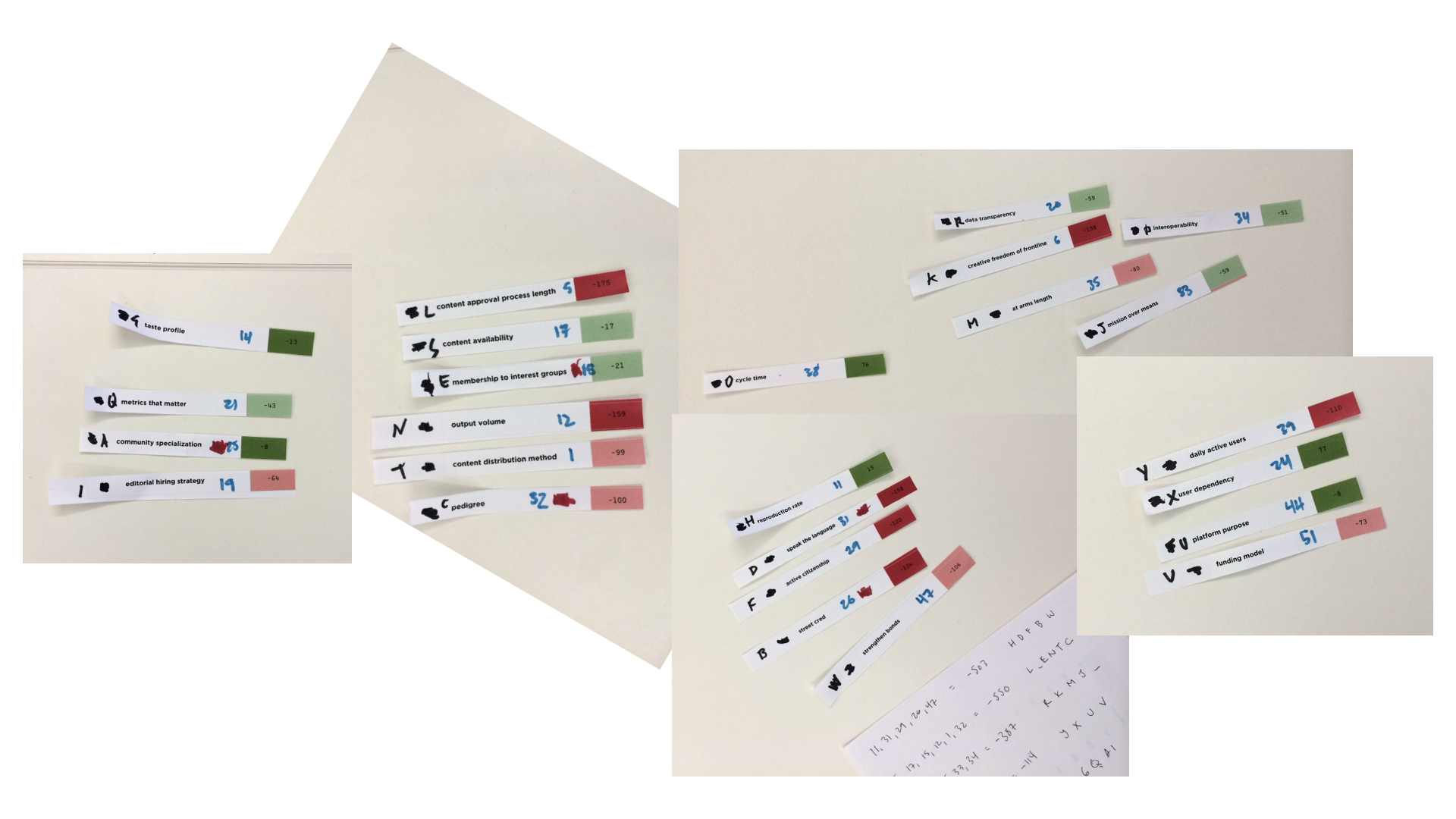
This way of looking at the problem changes everything for us. Instead of seeing the problem as one big thing that requires one big answer, we can start to see the interconnectedness of the problems and the solutions. We had new ways to intervene that make more sense for us and for our clients.
2015
We were the kind of consultants who stayed late arguing about the definition of “authority” while the rest of the floor went dark. Strategy work paid the bills, but the real puzzle—the one that kept us glued to whiteboards—was structure. Why did good ideas stall after the kickoff? Why did “high-potential” teams drift back to business as usual? By 2013 the hunch inside Undercurrent was clear: the operating system, not the PowerPoint, held the bottleneck. (Although PowerPoint continues to cause its own related problems.)
So we ran an experiment on ourselves. Via a blog post by Medium, we discovered Holacracy, an operating system that promised distributed authority, peer-defined roles that can be created or dissolved as needed, and clear decision rules. We installed it wholesale, and after a few weeks, our Monday all-hands meetings looked nothing like the agency stand-ups we’d grown up with. The language felt strange (“tensions,” “objections,” “integrative decision-making”), but the effect was magnetic. Projects moved faster, small teams formed and dissolved without drama, and client work picked up momentum we could see directly in our P&L.
We tried to tell our clients what was happening. Most of them looked at us the way you look at a friend who’s joined a particularly earnest cult. Like most people around that time—see Harvard Business Review’s “Beyond the Holacracy Hype”—they heard the enthusiasm and the jargon and tuned out. That reaction bothered me, because buried inside the legalistic way of describing “the new work” was a practical insight: Specific moves, used at specific moments, unlock better outcomes at essentially no cost. I needed a way to show that without asking an entire company to swap out its DNA.
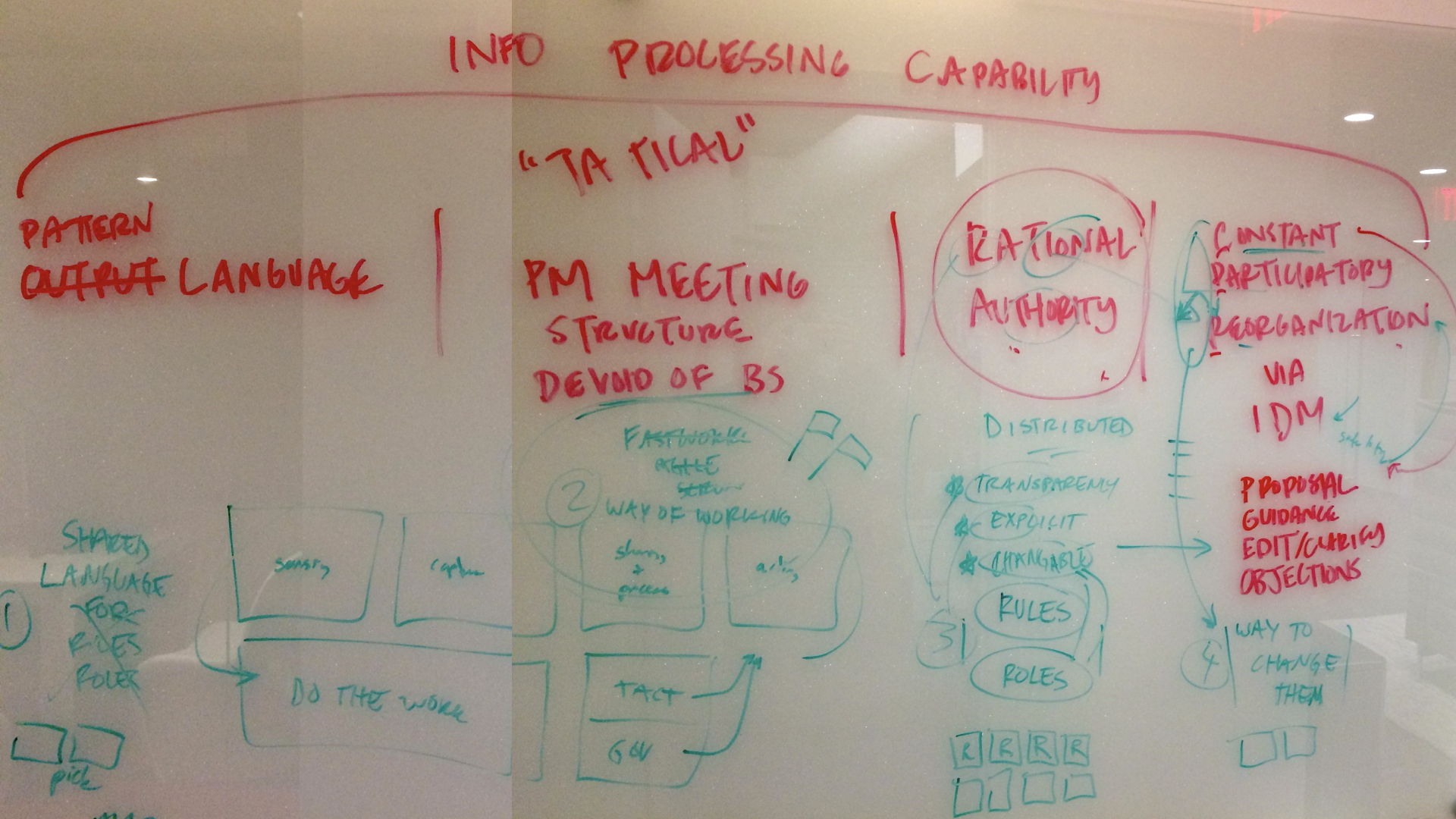
The breakthrough came at 7:24 pm on March 25, 2014. Aaron Dignan—my boss at the time and the eventual founder of organizational design consultancy The Ready and AI agent software company Plumb, as well as the author of Game Frame and Brave New Work—and I were huddled in a hallway, red and green markers squeaking across our signature glass whiteboards. I wrote “output language” in block letters, nodding to Holacracy’s tidy categories: roles, policies, projects. Those labels proved that even a rudimentary network of patterns can have a massive impact on how a company operates: Define a role with a few fixed properties, phrase every accountability the same way, and anyone can help shape the work. Without guardrails like these, self-governing systems drift toward representation and away from direct participation: A random citizen can’t just stroll into Congress and table a bill, so you need trained experts to bring your interests forward. By limiting proposals to just three clearly defined types—roles, policies, and projects—Holacracy lets any teammate bring an idea forward, no special training required. A beat later I slashed a line through “output” and replaced it with “pattern,” and the rest of the whiteboard snapped into focus.
In that moment, Christopher Alexander’s A Pattern Language (1977) became the blueprint behind this book and the foundation for a decade-long search for a way to help more people connect their intention to their output. In APL, Alexander, alongside architects Sara Ishikawa and Murray Silverstein, distilled decades of fieldwork into 253 remixable “patterns,” each numbered and described so that everyone—from architects to people picking a short-term rental—could bring unselfconscious but purposeful quality to their built environment. Their patterns are roughly arranged from gigantic and hard to change to quite small and shiftable. At the top end think of agricultural valleys (4), which describes how settlements thrive when they sit between fertile lowlands and protective slopes. A few hundred pages later, six-foot balcony (167) shows that a balcony meant for conversation will need to be at least six feet deep, while different chairs (251) nudges us to vary seating if we want real gathering.
Thinking about systems this way was incredibly clarifying for me: I needed to figure out how to take a coherent system for organizing work, shrink the various component pieces until they could fit on a miniature 2.75” x 1.1” Moo card, let people try one at a time, and let the big picture take care of itself. For example: We tried a super-obvious facilitation method that we started calling “Rounds”—participants speak in turn in response to a prompt, no interruptions. A simple Retrospective script built off of three questions that we encountered in a meeting with InsideOut Development: What worked? Where did you get stuck? What might we do differently next time? A Kanban board visible to the team and the client, each card with a title, a “why it matters” blurb, and the minimum rules for running it well. Simple stuff. Not always easy stuff.
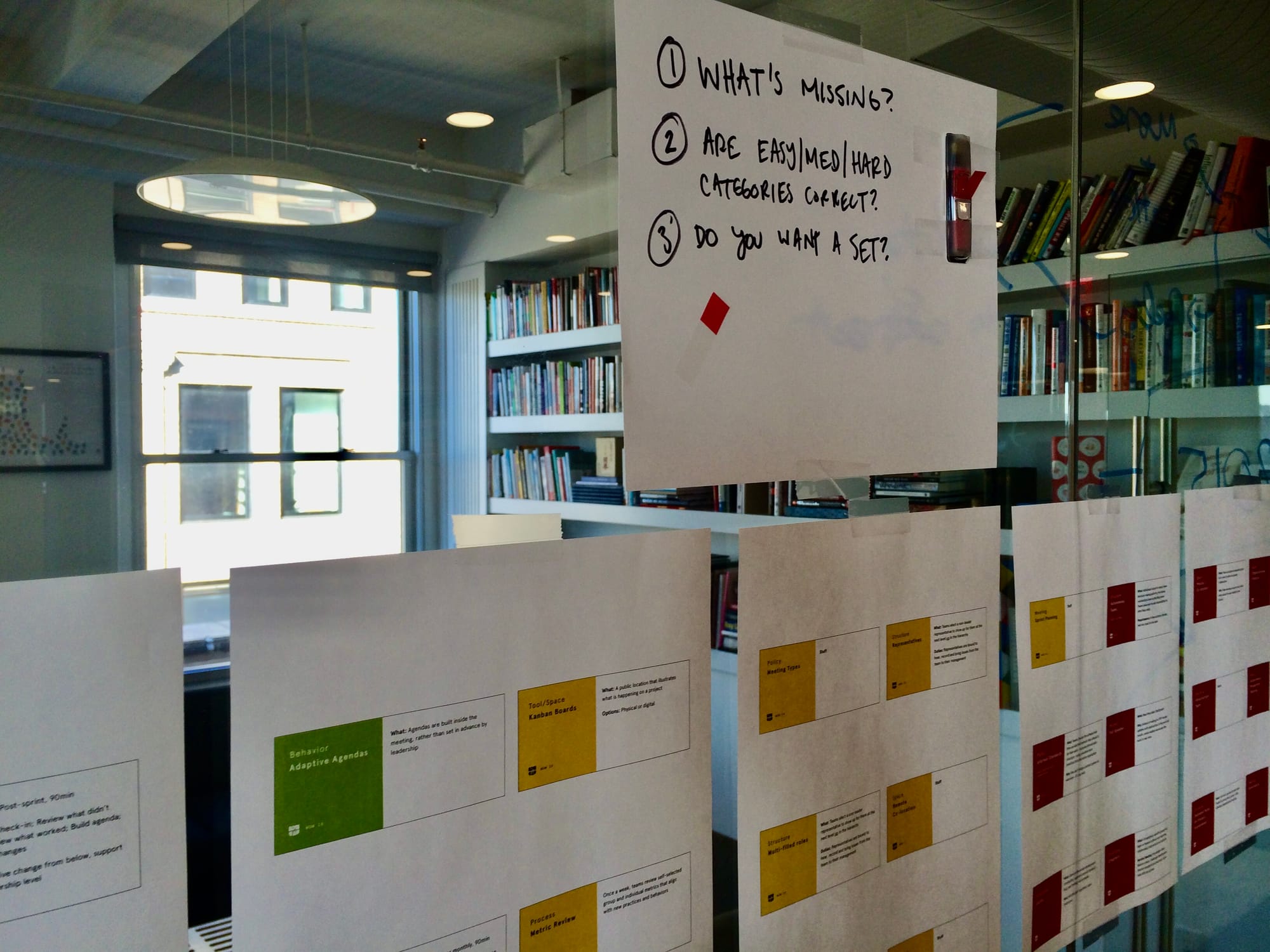
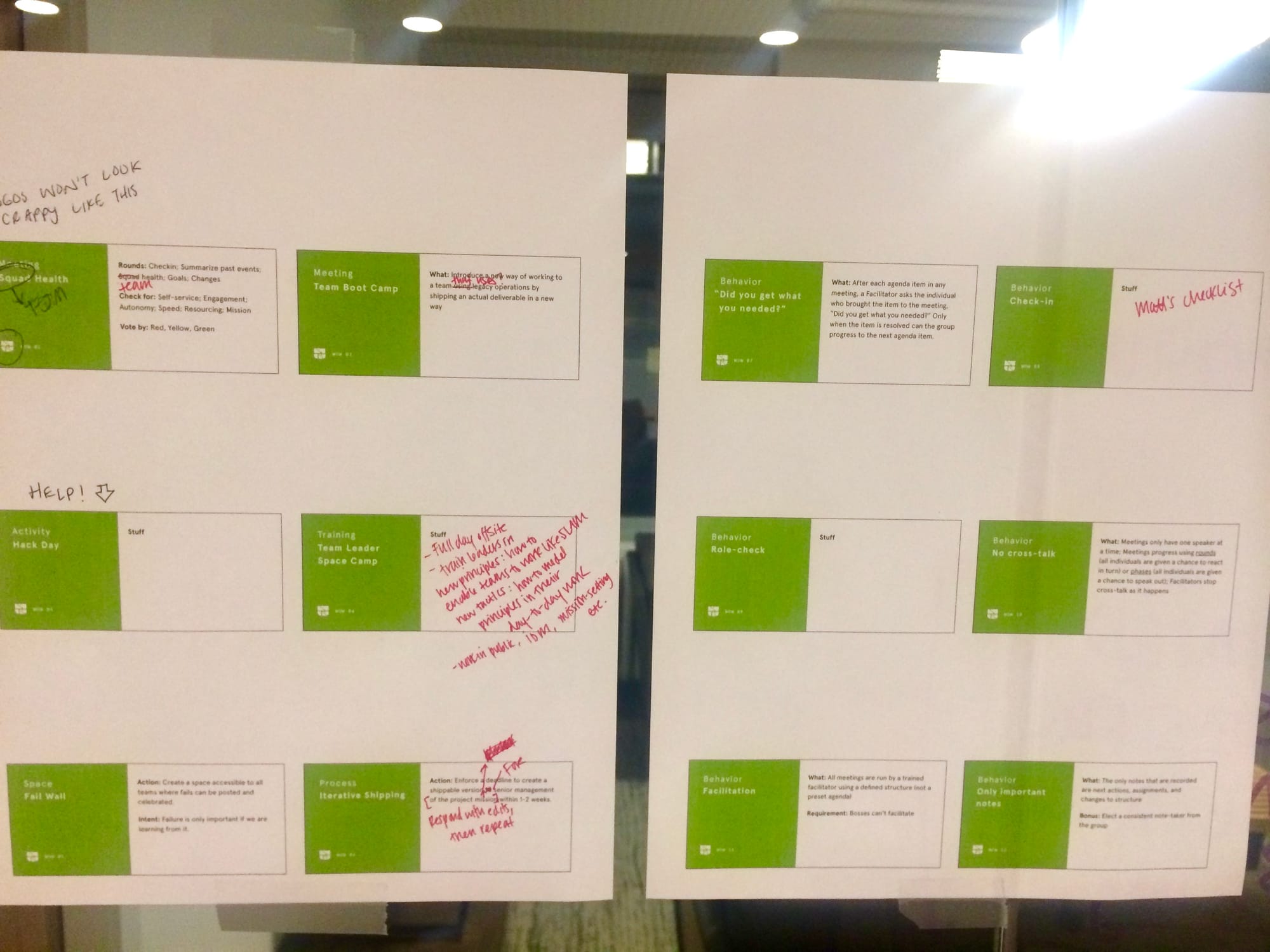
From October 2014: the Mini Moo cards in question. A few of the patterns here are still roughly shaped according to what we created back then!
Undercurrent’s story ended elsewhere (a story for another book, another day), but the pattern idea refused to die. When a few of us founded August, an organization design and team coaching consultancy, in 2015, the idea came with us and shaped everything from hiring to profit sharing. We kept adding things that seemed to work as we, and others in the broader community, came across them: the Colleague Letter of Understanding from a tomato-processing company in California; Harrison Owen’s Open Space Technology for large-group problem-solving; Amy Edmondson’s research on psychological safety, which reminded us that safety can be structural and cultural. Every project surfaced fresh variants. We wrote them down, tested them, kept what worked, tossed what didn’t.
A decade later August is still running with lean teams, clear scopes, explicit working agreements, and the pattern language is, if I may, baked into the walls. The patterns have multiplied, and I’ve moved on to Airbnb, but it’s still true for me that no concept survives if it can’t fit on one side of cardstock and be explained in under a minute.
This book is the next logical step: a permanent record of the patterns, organized so you can pick what you need, leave the rest, and move forward. A pattern, in these pages, is a proven response to a recurrent problem in modern work. It is not a silver bullet, a full operating system, or a promise of enlightenment. Think of it more like a chess opening or a mirepoix: humble, repeatable, waiting for you to adapt it to local taste.[1]
2016
A gray, drizzly afternoon in a small, forgettable conference room outside London. The space was cramped, greige, and a little damp, a stark contrast to the sleek innovation labs and vibrant open-plan offices where I typically found myself. But something special was happening here.
Around a cluttered table sat four junior employees from a global consumer goods company, each buried in their laptops. Their intensity was very real, eyes locked onto a shared Google Sheet.[2] For days, they had been quietly hacking away at a critical problem: reviving a product line that had been languishing for months.
Suddenly, one of them said, “We did it.”
Their faces lit up, mixing excitement with disbelief. These four had cracked the code by designing a pricing and packaging strategy that would soon reverse months of declining sales.
Just one week earlier, these same four employees had been stuck. Not in a room with their peers but silently at their desks. Not due to a lack of skills or ambition, but because their attention had been divided across endless meetings, reports, and interruptions that left no room for deep, focused thinking.
We had intervened, convincing their bosses (fifteen senior managers, consultants, and various administrators) to take a leap of faith: Clear these four people’s calendars completely, for just two weeks. Allow them to focus. Let them work without distraction.
The experiment was rudimentary, but it was one of the most valuable engagements in my company’s history. One team member later described the experience to me as transformative: “Honestly, this has been life changing. I finally feel like I’m doing something with my life. I’d been thinking about that problem for about a year, but never had any real time to work on it. Having solved that riddle, that way . . . I’ll never go back to the old way of doing things.”
In the weeks and months that followed, the impact of their two-week sprint radiated outward, reshaping the way teams across the organization approached work. The product line flourished, and so did the careers and lives of those involved.
Reflecting on this moment, I’m still struck nearly a decade on by how simple it was. No new technology required. No extra expense was really necessary. The team didn’t have to work harder. They didn’t need new skills or new head count. They just needed a clear team purpose and plenty of time to focus.
2021
Flash forward to a work session I hosted with a midsized CPG company while working at marketing-org change consultancy Black Glass—our client was well known enough to fill supermarket shelves nationwide, but not so large as to be a truly global family of brands. This was early 2021, so we were deep into remote working, all Zooming in from bedrooms and kitchen tables and, yes, closets.
The team assembled here was bright and accomplished—a project manager, a strategist, an art director, and a media planner—all eager, thoughtful, and exhausted. Each carried impressive credentials and deep expertise, but their energy had been drained by mundane tasks and uninspiring strategies. It wasn’t just the pandemic. The work itself was crushing their souls.
Originally, the brief from leadership had been modest: “Reduce campaign creation timelines from nine months to six weeks.” This was the kind of goal that rarely inspires passion or sparks ingenuity. Important, probably hard, but not especially interesting.
But we challenged this team to think differently, pushing them beyond incremental improvements to something genuinely transformative. “If you could redefine marketing entirely,” we asked, “what would you do?”
Their answer was bold, clear, and inspiring.
Instead of just speeding up timelines, they wanted to throw out the plan and work in direct connection to consumers, tastemakers, and the owners of the platforms where their audience spent their time, like Reddit and Twitch. Instead of routing ideas through senior leadership panels, they’d ship anything that wasn’t expressly disallowed by the brand guidelines. Cycle times dropped to minutes (from months), and the team’s work got smarter, and smarter, and smarter. It was no longer necessary to bring in research companies like Forrester (or similar) to share a generalized view of how to target and talk to Gen Z audiences. These millennial and Gen X marketers became fluent in the language of their people.
And yes, they even tried things with NFTs when that was relevant. While that moment has passed, for a company mostly considered to be behind the times, this was a coup.[3]
It’s worth noting that after laying out their ambition, they hesitated a bit: Bold ambitions like these rarely traveled smoothly through their company’s more traditional approval chains. Nevertheless, they took matters into their own hands, quietly building momentum without waiting for explicit permission. The work itself attracted more talent from across the company, turning a once-quite-chilled project into a vibrant, purposeful mission.
Six months later, their radical new way of working turned into a comprehensive marketing playbook for the organization. At its unveiling, the reaction wasn’t just positive, it was electric. Leaders actually applauded the team. The company found itself suddenly at the heart of industry conversations, admired by peers, envied by competitors.
And they ended up growing their share of wallet by four percentage points, each worth $100 million.
Reflecting later, it became clear what had made the difference. This is going to sound familiar at this point: The budget hadn’t changed, and neither had the people. We just recognized and then fixed the invisible roadblocks holding teams back from taking bold, meaningful action.
The Human Cost
These success stories are painfully rare. But what if we could repeat these wins (limited as they are) within every project, for every team, at every company?
You know that dysfunction is the norm rather than the exception. It comes at a staggering human cost, quietly draining potential and leaving behind a legacy of missed opportunities. It comes with a hit to the bottom line, as companies pour millions into strategic initiatives, leadership training, and process improvements.
And nothing fundamentally changes.
And as I write this at the end of 2024 and into the start of 2025, I’m worried that what we know about life at work—bad as it already is—is only going to get much worse.
Gallup’s surveys show that in the United States, barely a third of employees are actively engaged in their work. Another half are just going through the motions, disengaged and disconnected from any real sense of purpose. And most troublingly, a full 17% of employees are actively disengaged, essentially working against their employers and colleagues, contributing negatively to the very workplaces they’re paid to sustain.[4]
These numbers represent real lives, real dreams, and real potential wasted. Imagine the countless good ideas that vanish, unheard, every single day; the creativity stifled under layers of administrative tasks and approval processes; and the groundbreaking solutions remain locked away, never brought to life simply because their creators are buried under routine, uninspiring responsibilities.
The ripple effects of this dysfunction reach far beyond office walls, touching society as a whole. Disengagement drives slower economic growth, higher healthcare costs from stress-related illness, and thinner civic participation. Meanwhile, according to Deloitte, purpose-driven organizations vastly outperform their purposeless counterparts in virtually every meaningful metric, from employee and consumer trust to genuine innovation and even true adoption of diversity and inclusion initiatives.[5] But most teams cannot even articulate their mission clearly, let alone pursue it effectively.
Again, there are lives at stake. Studies have consistently linked workplace dissatisfaction and chronic stress to severe mental health outcomes, including anxiety, depression, and burnout. A report by BambooHR noted that employee satisfaction scores fell precipitously between 2022 and 2023. Fifteen times faster than the prior two years combined.[6] Workers today are more exhausted, more overwhelmed, and less fulfilled than at any time in recent memory.
And while innovation stagnates, productivity somehow continues to rise: Between 1973 and 2014, worker productivity increased by 72%. But wages climbed a mere 9%.[7] Workers today are nearly twice as productive as their counterparts decades ago, yet they see little of this reward. This divergence between productivity and pay is a reflection of how deeply our organizations have distorted, favoring short-term efficiency over sustainable human flourishing. And even though it is true that productivity is rising, “number go up” is hardly satisfying in the face of our felt reality: that most hours, most days, for most people, are spent on unnecessary administrative tasks, endless meetings, and cumbersome bureaucratic procedures.
Imagine instead a world where those billions of lost hours spent were redirected toward meaningful work. Work that fulfills, inspires, and genuinely innovates. Work that pays exceptionally well because it’s performed in a context that prioritizes equity and performance in equal measure. Evidence from four-day-workweek studies suggests it’s possible to achieve the same productivity in less time, potentially returning hundreds of hours annually back to employees to invest in family, community, and personal growth.
The opportunity cost of our current dysfunction is enormous. It’s measured in dollars and in lives wasted and possibilities unrealized. It’s a managerial issue. It’s a deeply human problem.
One of my favorite things about learning to cook is all the different kinds of holy trinities out there. Once you learn them, you can cook just about anything, and it’s literally just three vegetables (more or less) that make a dish taste like a region. ↩︎
Quick note: Google Sheets were specifically not allowed at this company, but there was no way they were going to be able to collaborate in real time on this financial model on Excel in 2016. No matter how much you like Excel—and you’d be right to like it—it’s still so difficult to work in real time with others on the same .xls document. ↩︎
Are we saying “coup” in 2026? ↩︎
Jim Harter, “U.S. Employee Engagement Sinks to a Ten-Year Low,” Gallup, January 14 2025. Gallup’s latest panel survey finds 31% of US employees engaged, 52% not engaged,” and 17% “actively disengaged,” confirming that barely a third feel connected to their work while a sizable minority work against their employers. ↩︎
Deloitte Insights, “Purpose Is Everything: How Brands That Authentically Lead with Purpose Are Changing Business,” October 15 2019. Deloitte’s global research shows purpose-driven companies grow three times faster, gain higher market share, and report 30% more innovation and 40% better retention than purposeless peers, outperforming across trust, innovation, DEI adoption, and employee engagement. ↩︎
BambooHR LLC, “The Great Gloom: Employees Are Unhappier Than Ever, According to BambooHR’s Employee Happiness Index by Bamboo HR,” press release, August 29, 2023. The study reports an 11% drop in employee eNPS from June 2022 to June 2023: nearly 15 times faster than the prior two-year decline. ↩︎
Josh Bivens and Lawrence Mishel, “Understanding the Historic Divergence Between Productivity and a Typical Worker’s Pay: Why It Matters and Why It’s Real,” Economic Policy Institute, September 2, 2015. Using BLS data, the authors find that between 1973 and 2014 labor productivity grew 72.2%, while hourly compensation for the typical worker rose just 9.2%. ↩︎
Why Change Fails
Across decades, organizations have cycled through waves of management trends, each promising transformative change. Yet most leaders quietly acknowledge that despite good intentions, lasting improvement remains elusive. Why?
For one: top-down change is fun for executives who are bored with their work.
These ambitious, sweeping initiatives, often championed by charismatic execs, typically follow a predictable rhythm. They start with bold announcements, big training programs, and meticulous rollout plans. A year or two later, these grand strategies often dissolve quietly, leaving behind only glossy brochures and frustrated employees. The reason is simple: Real change cannot be imposed solely from above. Transformation demands more than executive decrees or cascading key performance indicators (KPIs): It requires deep engagement and ownership from those who actually do the daily work.
Then there’s the ultimately misleading notion of “best practices.”
Execs, eager for success, frequently look outward, searching for neatly packaged solutions validated by external benchmarks. But what worked beautifully at a Silicon Valley tech giant or an iconic manufacturing brand seldom translates directly to your own unique context. Context matters. Leaders visit renowned innovators and become enamored with visible artifacts, like open-plan offices, agile rituals, elaborate brainstorming sessions, or the latest book by a hand-wavy consultant. (How meta!) Believing that success is found in copying what others have done, companies invest heavily, only to discover later that they’ve replicated the “what” without grasping the “why.” Those things that worked elsewhere only worked because they came to existence in a web of supportive tissue.
And beneath all of this is the human element. Change initiatives overlook the lived experiences, hopes, fears, and frustrations of the people they aim to influence, relying heavily on logic, data, and structural adjustments. In my experience, employees don’t resist because they’re stubborn or averse to change, but because they sense intuitively when changes will be bad for them. Without recognizing and honoring this human reality, even the best-designed change programs inevitably fall short.
Two things are clear about these common routes to failure: a) They suck the life and energy out of an organization; b) They’re signals pointing toward deeper systemic issues. To create genuine, lasting change, we must shift our approach entirely.
What if there were a fundamentally different way? What if there was a method of change rooted not in grand plans, external solutions, or charismatic leadership but in something subtler and far more powerful?
👋 Hello, and Welcome to
Pattern Thinking and Doing 👋
Pattern thinking and doing acknowledges that meaningful change can and does begin anywhere, at any level. It doesn’t require formal authority or a big budget; instead, it relies on small actions and decisions made in daily routines. Consider the junior team from our earlier story, quietly transforming an entire product line simply by creating space for focused attention; all it took was recognizing and adjusting one small but significant problem: distraction.
This capacity to make change without positional power is the extraordinary potential of small moves. Especially if everyone makes moves. Tiny adjustments in daily behaviors, meeting formats, or decision-making routines can and do ripple outward, reshaping entire organizations over time. Each little shift changes the underlying patterns of interaction, communication, and decision-making, creating impact far beyond the initial scope. Authentic transformation happens through persistent, thoughtful adjustments made over time.
Pattern thinking and doing empowers individuals at all levels of an organization to see differently: to observe their environment through a lens of interconnected patterns rather than isolated problems. Rather than becoming overwhelmed by complexity, people begin recognizing recurring issues, hidden opportunities, and subtle leverage points for change. The simple act of seeing these patterns clearly changes how teams engage with their work, their colleagues, and the larger organizational mission.
Building better organizations is something for all of us, where every person feels equipped to make meaningful improvements from wherever they stand. It’s never been the case that leaders bear sole responsibility for change, but in working this way we’re recognizing that the role of “leader” shifts to nurturing conditions where pattern recognition and thoughtful experimentation flourish. By applying patterns associated with small-scale trials, transparent sharing of insights, and safe spaces for reflection, leaders help cultivate a culture of continuous, authentic learning.
Pattern thinking and doing offers, and relies on, a hopeful vision of the future. It reminds us that the keys to transformation are already present, embedded in everyday routines and interactions, waiting only to be recognized and reshaped. In this book, you’ll learn how to spot these hidden opportunities, understand their dynamics, and intervene to create lasting positive change. Welcome to a new way of seeing, and doing, organizational design.
How This Book Works
If you picked up this book, I assume that you are one of the great many impatient folks out there who know that we need a gigantic change in the way that we work. (I also assume that you do not need to be convinced that there is something better out there.) You’ve seen the slide decks and TED Talks that promise agility, customer obsession, cloud-native reinvention, AI transformation . . . and then watched as nothing substantial changed about how work got done for those around you. We’ve established that one of the big challenges facing the impatient is that we ask or hope for big-bang changes. Five stories in a single bound. This book contains the risers, the treads, and the framing that build the stairs to where you want to go. It contains 75 individually named patterns:
Each pattern describes a problem that occurs over and over again in our environment, and then describes the core of the solution to that problem, in such a way that you can use this solution a million times over, without ever doing it the same way twice.—Christopher Alexander §
They are organized from the deepest and most philosophical patterns I’ve found along the way—true purpose (1), rule of law (2), and structural & psychological safety (3)—to the most tangible and tactile: movable everything (75), whiteboards at intersections (74), hiding places (73). As a result, there are at least four ways to read, and use, this book:
- Read it front to back Begin with purpose, safety, and governance, then layer on structure, rhythm, and space. If you love root-cause analysis or you’re redesigning an organization from scratch, this is your jam.
- Read it back to front Start with the surface stuff that you can change tomorrow and work backward through to bedrock constraints. Great for teams that need relief now and can’t wait for the enterprise to catch up—or for local offices of large companies that are outside the all-seeing eye of corporate.
- Pick a starting point your stakeholders actually care about Flip to the Goal Index in the back of this book. Find the Stakeholder Goal that’s burning a hole in your leadership agenda. Under that goal, locate the patterns with the highest numbers on the list. It will be something concrete you can pilot next week. Run it. Log what you learn. Then climb down the list toward the deeper patterns that underpin your goal.
- For agility, this will mean starting with something like process on the wall (68) or adaptive agenda (49), rather than expanded available power (4). One of my clients that adopted similar patterns saw a 40x improvement in project completion pace on like-for-like work. Another particularly stuck team saw a 200x improvement.
- For engaged culture, maybe try no leadership offices (70) or rounds (48). One client put these patterns to work and saw a 40-point jump in autonomy, customer connection, iteration, and decision-making, a 17-point gain in inclusion of diverse views, and an 87-point Net Promoter Score (NPS) for the patterns themselves.
- For innovation, try fail wall (69) or retrospectives (66). Patterns like these underpinned ideas that delivered $750 million in new revenue in a single category and (I’ve already mentioned this case, above) drove $400 million in share gains with zero extra spend.
- For quality execution (this is the biggest goal-oriented section by far, which highlights, at least for me, how this movement is about going toward accountability rather than away from it), try space for work (72) or one of my favorites, cadence (65). Results: My client teams cut escalations to leadership by 64% and reversed a profit slide, ending up at 2x their previous growth rate.
- For strategic clarity, try team charter (43) or future backward (42). Media teams I’ve helped use these patterns outperformed industry peers by 2x, while a category president told us, “Without this, we couldn’t compete against clever, fast-moving outliers.” Oh, and teams also spent 70% less time on non-value-added busywork.
- Pick a starting point you care about Let’s say you’re a CEO or president or equivalent, and you’ve fallen in love with the Haier RenDanHeyi case study, where hundreds of thousands of employees have reorganized into thousands of entrepreneurial teams. Exciting. You want to announce, “From next quarter we’ll operate as microenterprises!” Skip the temporary excitement, confusion, and eventual reorg that looks suspiciously like the old org chart and start with network of teams (13), which describes autonomous squads, tight customer feedback loops, and promises cycle times that shrink from months to weeks. These are very real outcomes that you should expect if you can implement that pattern. But its implementation presumes (at least):
- dissolvability (9) where teams, roles, and even whole processes are presumed temporary, ready to vanish when their job is done. Without this higher-order assumption of impermanence, networks harden instead of flex.
- distributed management (14) where everyday leadership chores are shared within a team, not exclusively above them.
- talent marketplace (20) where people can slide across teams quickly, so capacity matches shifting bets.
- domains, assets & standards (23) so everyone knows what they own and what they must not break.
- boundary management (67) making handoffs explicit, so speed doesn’t bleed into chaos.
Skip these layers and your network will likely collapse under staffing bottlenecks, decision wrangles, and Service Level Agreement (SLA) debates. Work the chain from small to big: prototype boundary management inside one product group; adopt domains & standards to make those boundaries real; launch a lightweight talent marketplace so squads can restaff in days; practice distributed management so authority sits with the work. Keep dissolvability visible and top of mind: Teams should expect to end themselves once the mission is met. Only when those muscles are built should you talk about the network everywhere.
What’s in a Pattern?
- Problem. A concrete gripe you’ve probably voiced aloud.
- Pattern. The recurring solution, distilled into a two-sentence “therefore…”
- Why it works. A quick sketch of the social, economic, and/or cognitive mechanics.
- Connected patterns. Your map to the next experiment.
- Things to try. An action you can run this month with one squad.
- (In many cases) Common traps. Because someone, somewhere, has already tried a bad version so you don’t have to.
These patterns are organized into thematic categories:
Foundations
Bedrock principles upon which effective organizations are built, covering essential aspects like shared purpose, transparency, and trust. You’ll find patterns here that create clarity about why teams come together, how purpose shapes boundaries, and why trust and openness are necessary for long-term success.
- True Purpose: The enduring reason that drives meaningful action and connects individuals, teams, and organizations to shared goals.
- Rule of Law: Nobody in the organization is above the rules that the org sets for itself.
- Structural & Psychological Safety: Psychological safety allows for innovation and learning, while structural safety ensures that decision rights and organizational status are protected.
- Expanded Available Power: When leaders give away some of their decision-making authority and resources to other levels, innovations and adjustments in course are possible without the say-so of the boss.
- Curiosity: Lead with wonder, and allow rapid experiments and shared insights to outpace tidy certainty.
- Do No Harm: Actively prevent unnecessary harm, whether to employees, communities, or the environment.
- Wholeness: Allow employees to bring their full selves to work.
- Role-Soul Distinction: Decouple your personal identity from your professional roles.
- Dissolvability: Teams, roles, and processes should be assumed to be temporary and regularly reassessed.
- Consent & Consensus: Distinguish between consent (acceptable) and consensus (actively supported).
- Pace Layers: Different aspects of an organization evolve at different speeds; structure decision-making to respect these layers.
- Cooperation: Cooperation thrives in environments where discord is acknowledged and structured into productive negotiation.
Structuring
These patterns illuminate how to thoughtfully shape teams, departments, and even entire organizations. From deliberately small, autonomous groups designed for agility to interconnected yet independent units that support resilience, these patterns help you understand how structure impacts innovation, collaboration, and efficiency.
- Network of Teams: Networks of teams balance autonomy with structured coordination through explicit interfaces and protocols.
- Distributed Management: Management responsibilities are shared within a team, rather than centralized in an individual human.
- Elections: Leaders are chosen through structured elections rather than appointments.
- Purpose, Customer, Platform: Structure the organization around purpose-driven customer needs, with platforms enabling customer-focused work.
- Platform Teams: Internal support teams (HR, finance, IT) function like product teams, offering scalable self-service tools.
- Self-Managed Teams: Teams operate autonomously within clear boundaries, making decisions independently.
- Lean Teams: Small, focused teams outperform large teams by reducing complexity and improving execution.
- Talent Marketplace: A digitally enabled marketplace for talent and work within the organization.
- Guilds: Cross-team communities that voluntarily share knowledge and learning.
- Chapters: Role-based communities set standards and share best practices, allowing teams to remain independent.
- Domains, Assets & Standards: Clear ownership of domains and assets reduces friction; each team knows its decisions and resources.
- Upward Representation: Teams select representatives to participate in higher-level decisions, ensuring decisions reflect teams’ input.
- Team Incentives: Incentives structured at the team level promote collaboration instead of competition.
Direction
Clear, compelling visions and making decisions inclusively and effectively. Patterns around transparent goal-setting, decision-making frameworks that favor clarity and consent over slow-moving consensus, and strategies for clear, purpose-driven communication are outlined.
- Do the Right Thing: Clarify long-term purpose before optimizing execution.
- Active Steering: Empower teams to make frequent, smaller adjustments rather than relying on rigid plans.
- Objectives & Key Results: Define ambitious objectives with measurable results to track and adjust progress.
- Strategy Heuristic: Simplify strategy into memorable rules that clarify decision-making.
- Structured Decision-Making: Use explicit, transparent processes for making major decisions.
- Advice: Separate input from decision-making authority to increase valuable feedback.
- Transparency: Default to open information sharing, balanced with privacy when necessary.
- Relative Targets: Use relative performance benchmarks rather than rigid annual budgets or goals.
- Pull Updates: Leaders directly access updates rather than relying on reports.
- Demos: Replace status reports with demonstrations of actual work.
- Metrics Review: Regularly integrate performance metrics into discussions.
- Backlog Management: Maintain a clear backlog to keep priorities explicit and transparent.
- Conflict as a Resource: Treat constructive conflict as essential and beneficial for progress.
- Conflict Resolution: Implement clear, structured methods to resolve conflict effectively.
- Colleague Letter of Understanding: Explicitly document working agreements among colleagues.
- Open Space Technology: Run self-organizing, participant-driven workshops.
- Future Backward: Envision ideal outcomes first, then identify steps needed to achieve them.
- Team Charter: Explicitly define team purpose, roles, decisions, and processes in writing.
Practice
The routines, habits, and processes that support great work. These patterns aren’t mere procedures but deep practices: frequent retrospectives that promote continuous improvement, simple communication habits that build trust, and lightweight documentation approaches that enable rapid learning and adaptation.
- Check In & Out: Brief check-ins at meeting start and end create space for presence and connection.
- Only Important Notes: Limit notes to decisions, key changes, and actions to reduce information overload.
- Iterative Shipping: Frequently share work in progress for early input rather than polishing in isolation.
- Action Meeting: Structure meetings explicitly around actions rather than passive discussion.
- Rounds: Structured turns in conversation to be sure everyone has a voice without interruption.
- Adaptive Agenda: Keep meeting agendas flexible and dynamically prioritized.
- Work in Public: Make work visible through shared documents and dashboards instead of private updates.
- Meeting Roles: Clearly assigned facilitator, notetaker, and timekeeper roles keep meetings structured (but that’s only the start).
- Triage: Assess and categorize issues by urgency and importance before tackling them.
- Have One Conversation: Meetings should have a single conversation at a time for discipline and clear focus.
- Pairing: Pair work enhances learning, quality, and shared problem-solving.
- Kanban: Use visual task boards to clarify workflows and priorities.
- Facilitation: Skilled facilitation structures conversations and supports decision-making.
Learning
Patterns to cultivate learning at every level. Patterns in this section emphasize the importance of continuous feedback, safe-to-fail experimentation, and proactive knowledge sharing across boundaries. You’ll learn how to build cultures that naturally evolve, grow, and thrive through ongoing, collective learning.
- Logbook: Record key decisions and insights in a team logbook to track progress and history.
- Emergent Leadership: Leadership emerges from expertise and context.
- Health Check: Regularly assess team and process health to proactively identify issues.
- Hack Day: Periodically dedicate time to explore new ideas freely outside regular routines.
- Flow State Work: Design environments that support focused, uninterrupted periods of deep work.
- Experimentation: Regularly test new ideas through small experiments to continuously improve.
- Team/Process as Product: Apply product management thinking to continually refine how teams operate.
- Length Limit: Impose explicit length constraints on assignments and policies.
- Cadence: Establish consistent cycles for work and reflection to sustain steady progress.
- Retrospectives: Regular team reflection sessions identify improvement opportunities.
- Boundary Management: Clearly define role and team boundaries to prevent confusion and enhance accountability.
Space
The physical and virtual environments that shape daily interactions and productivity. These patterns consider how environments can either nurture creativity or (oops!) hinder it. You’ll get insights into creating spaces that actively encourage the behaviors, interactions, and cultures your organization seeks.
- Process on the Wall: Make workflows visible and accessible by putting processes on display.
- Fail Wall: Publicly document failures and learnings to normalize experimentation.
- No Leadership Offices: Leaders sit with teams to reinforce transparency and approachability.
- No Assigned Desks: Flexible seating encourages collaboration.
- Space for Work: Design physical spaces intentionally around the types of work performed.
- Hiding Places: Provide quiet, private spaces for focused, uninterrupted work.
- Whiteboards at Intersections: Place whiteboards in common areas to encourage spontaneous collaboration.
- Movable Everything: Furnish the workspace with flexible, movable elements to adapt quickly.
Pattern Connections
Let’s start somewhere simple, like hiding places (73): spaces explicitly designed for quiet, focused work. Many corporate offices thoughtfully and expensively provide these spaces. I toured an amazing new telecom HQ some years ago and found that every single one was unused. But all the open-plan desks and meeting rooms were full. Asking around, it turned out that this was the norm.
Why?
Tracing backward from hiding places (73) reveals a web of reasons why these spaces went unused. People don’t use hiding places that are designed for deep work in public because there isn’t a cultural acceptance or expectation for flow state work (61). It just doesn’t happen during the workday, so the main zones for this mode of working are my couch at home on the weekend and talking to myself on my commute. Deep work isn’t actively encouraged, and employees worry about being seen as unproductive or unavailable.
Some part of this could be solved with a cadence (65) that allows for deep work, rather than an unpredictable slurry of back-to-back 1:1s and status meetings from 8 am to 6 pm.
But why even worry about changing the schedule? After all, the job of a manager (and it would appear that most people in an office building are some kind of manager—or have that word in their official title) is to manage, which means you need to be in a lot of meetings. That’s because distributed management (14) doesn’t exist: All of the management tasks are trapped in one person, rather than being broken out and given to the people who can do those tasks best.
And why haven’t they tried to spread the wealth? No structural and psychological safety (3). Because there are no team incentives (25) baked into the structure. But also because most meetings are leader led, without facilitation (56), to say nothing for hearing every voice in the room via rounds (48).
An insights leader at one of the large consumer packaged goods (CPG) organizations that I worked with in the past mentioned to me that one of their recent billion-dollar new brand launches would have ended up on the cutting room floor if not for a multiyear new-way-of-working program that was built on top of these patterns. And it sounds unreasonable to say that the best way to invent a new, market-making brand is to take turns in conversation to be sure everyone in a meeting gets to speak.
But that’s the truth.
What’s Not in This Book?
You might wonder why certain common buzzwords, like “feedback,” don’t appear as patterns here. It’s intentional.
In my experience, feedback itself isn’t a pattern; it’s a behavior embedded within patterns like advice (31), lean teams (19), and experimentation (62). Patterns offer structural conditions that support effective feedback, rather than trying to prescribe giving and taking feedback. You also won’t find feedback directly mentioned here because the quality and utility of feedback depend entirely on the safety, context, and connection between people and their work. Without structural safety (3), without a clear linkage to the meaningful work of a team, feedback is empty (regardless of whether it’s critical or positive).
Similarly, this book doesn’t present technology-first solutions. Technology isn’t the point. Apps and platforms help only when they serve a solid pattern; chase them for their own sake and you just collect shiny distractions. The real leverage lives in how we interact, decide, and share power—all of which can run perfectly well with nothing more than a whiteboard.
Accountability also isn’t a single idea you can bolt on; it’s the sum of several other patterns working in concert. When roles are clear (team charter 43), information is visible (logbook 57), decisions follow agreed rules (rule of law 2), and work rhythms automatically surface indicators of progress (cadence 65), accountability shows up automatically. Strip away any of those conditions and what leaders call “accountability” is really just code for “I don’t think that person over there is doing their job very well.” Because it emerges from a lattice of patterns rather than existing as a freestanding idea, I’ve kept it off the list.
Also absent here are “values”: those abstract, often aspirational words listed on office walls but rarely embodied in everyday actions. Values statements can be inspiring, but they aren’t a pattern. Patterns like true purpose (1) and rule of law (2) will do most of the work leaders hope their values statements might—but rarely do.
Finally, you might wonder why diversity isn’t explicitly outlined as a standalone pattern. Authentic, sustainable diversity, meaningful equity, and true inclusion emerge from a combination of deeper, underlying patterns. True diversity arises as a direct consequence of consistently applied policies and behaviors that actively dismantle barriers and expand opportunities. As an example, when an organization commits to structural safety (3), emergent leadership (58), distributed management (14), upward representation (24), and genuine wholeness (7), diversity is supported on a permanent, thorough basis. Diversity thus becomes an organic and inevitable outcome, rooted deeply in the structures and practices of the organization itself.
In this book, you’ll find patterns that lay groundwork for healthier, more humane workplaces rather than prescriptive tactics masquerading as guaranteed quick fixes. The omissions you find here are deliberate. They reflect my belief in the power of underlying structural and behavioral conditions to produce lasting, genuine change.
A Different Kind of Playbook
“Best practices” break. They’re alluring because they’re easy to adopt: clearly defined, seemingly reliable solutions borrowed from other successful organizations. But they inevitably fall apart, because what makes something work in one place rarely matches exactly what’s needed somewhere else. Best practices fail precisely because they lack context.
Patterns have an edge because they explicitly provide these connections. The patterns are the context! Every pattern in this book connects logically and practically to others, forming chains of change that reflect genuine organizational realities.
This book prioritizes principles over procedures. Each pattern is a tested, fundamental idea, not a formula. If the examples or templates don’t seem immediately relevant, that’s fine. The core principle is what matters. Take the idea, apply it flexibly, and test it out. Make it your own.
Finally, emphasize adaptation over adoption. Please don’t treat patterns like rules; I hope you see them and use them as ideas that take shape within your own environment. They’re meant to be bent, experimented with, and improved upon until they fit. So encourage real problem-solving over following rules, and empower your teams to act decisively, pragmatically, and effectively.
The Power of Scale
Starting small isn’t the same thing as thinking small. Imagine this: 100 teams, each with about 10 people, decide to thoughtfully rework their team charters. This is relatively easy work that will not take any of these teams much time or effort. Looking at each individually, you might miss the size of the impact they’re creating. Seen collectively, it’s 1,000 people realigning their roles, clarifying decision rights, sharpening their focus, and reclaiming valuable hours for meaningful work. Small moves, replicated at scale, have immense transformative potential.
When you shift a single small practice—like reducing unnecessary meetings or restructuring daily decision-making—you create room for the work that matters most. Removing just two unnecessary meetings per week gives each team member back hours of deep, productive time. Multiply that across your entire organization, and suddenly thousands of hours are available again for focused, creative, and genuinely fulfilling work. Every 2,000 hours we get back is the same as adding an entire person to the team. And it costs nothing.
Momentum builds quickly once patterns take hold. Say your team experiments with something simple, like check in & out (44) or adaptive agenda (49). Suddenly, meetings become sharper, quicker, and easier. Conversations feel safer, which means teams become comfortable handling more difficult issues head-on. Now, something like conflict as a resource (38) is both feasible and welcomed. Before you know it, teams interact more fluidly, naturally evolving toward a network of teams (13). Each small pattern reinforces others, creating a powerful cycle of positive change.
Connecting local improvements to global change comes down to visibility and replication. When one team finds success with a new pattern, openly sharing that success inspires and encourages others. I’ve seen firsthand how local experiments become global movements when their impacts are shared and celebrated.
That team I described from the London conference room ended up trying and implementing more patterns—notably rounds (48), iterative shipping (46), and team/process as product (63)—that spread across the entire organization. If you handed the whole organization this book and said “here, do all 75 of these patterns,” none of it would ever stick. The point is starting somewhere and communicating a small set of memorable things that can spread socially, peer to peer.
Okay. Let’s dive in.
Send me a receipt showing that you pre-ordered the book, and then sign in. You'll get a magic link and then all these chapters are yours to read.