

I'm trying to not write about my own projects in Radar, but the first results from my survey on the prevalence of Hidden Patterns in organizations are interesting enough that I'm making an exception. Seventeen people have taken the survey so far, so a tiny sample, but the signal is already interesting.
What this is
It's a survey I built to answer a simple question: do the 75 patterns in Hidden Patterns actually correlate with organizational performance? I know that I like them and I have good, company-by-company data that they work (excerpted from the Intro):
One of my clients that adopted similar patterns saw a 40x improvement in project completion pace on like-for-like work. Another particularly stuck team saw a 200x improvement.
[...another] client put these patterns to work and saw a 40-point jump in autonomy, customer connection, iteration, and decision-making, a 17-point gain in inclusion of diverse views, and an 87-point Net Promoter Score (NPS) for the patterns themselves.
...Patterns like these underpinned ideas that delivered $750 million in new revenue in a single category and drove $400 million in share gains with zero extra spend.
...My client teams cut escalations to leadership by 64% and reversed a profit slide, ending up at 2x their previous growth rate.
...Media teams I’ve helped use these patterns outperformed industry peers by 2x, while a category president told us, “Without this, we couldn’t compete against clever, fast-moving outliers.” Oh, and teams also spent 70% less time on non-value-added busywork.
...but do the companies that adopt these patterns measurably outperform the ones that don't? Or was it just luck?
Survey design: respondents self-report on three health indicators (revenue growth, employee engagement, and advocacy), which classifies them as High Performing or Everyone Else. Then they rate 15 randomly assigned patterns on a 5-point Likert scale. It takes five minutes, and it's anonymous. Each respondent sees a different subset, so as volume grows I get coverage across all 75.
So far, so good
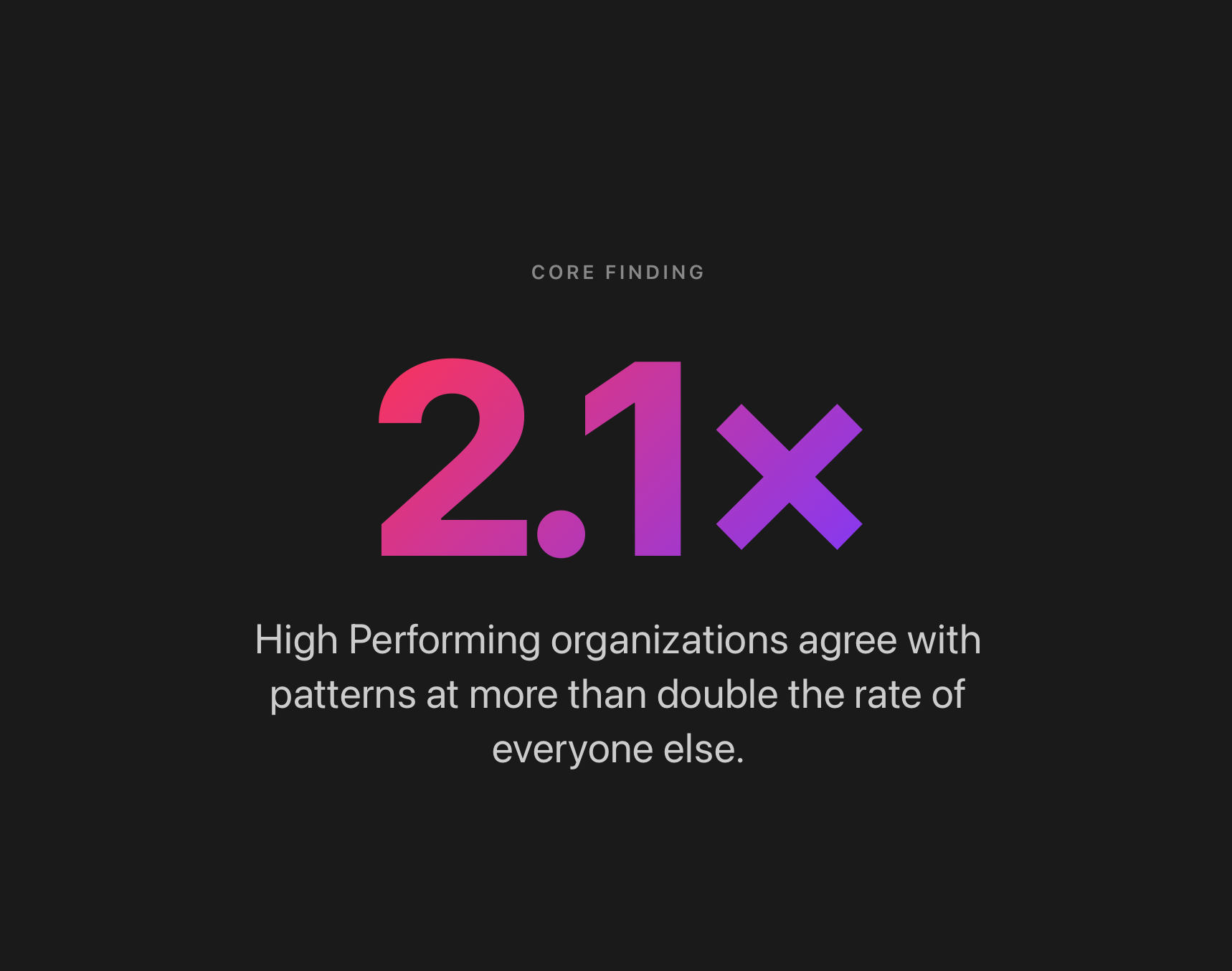
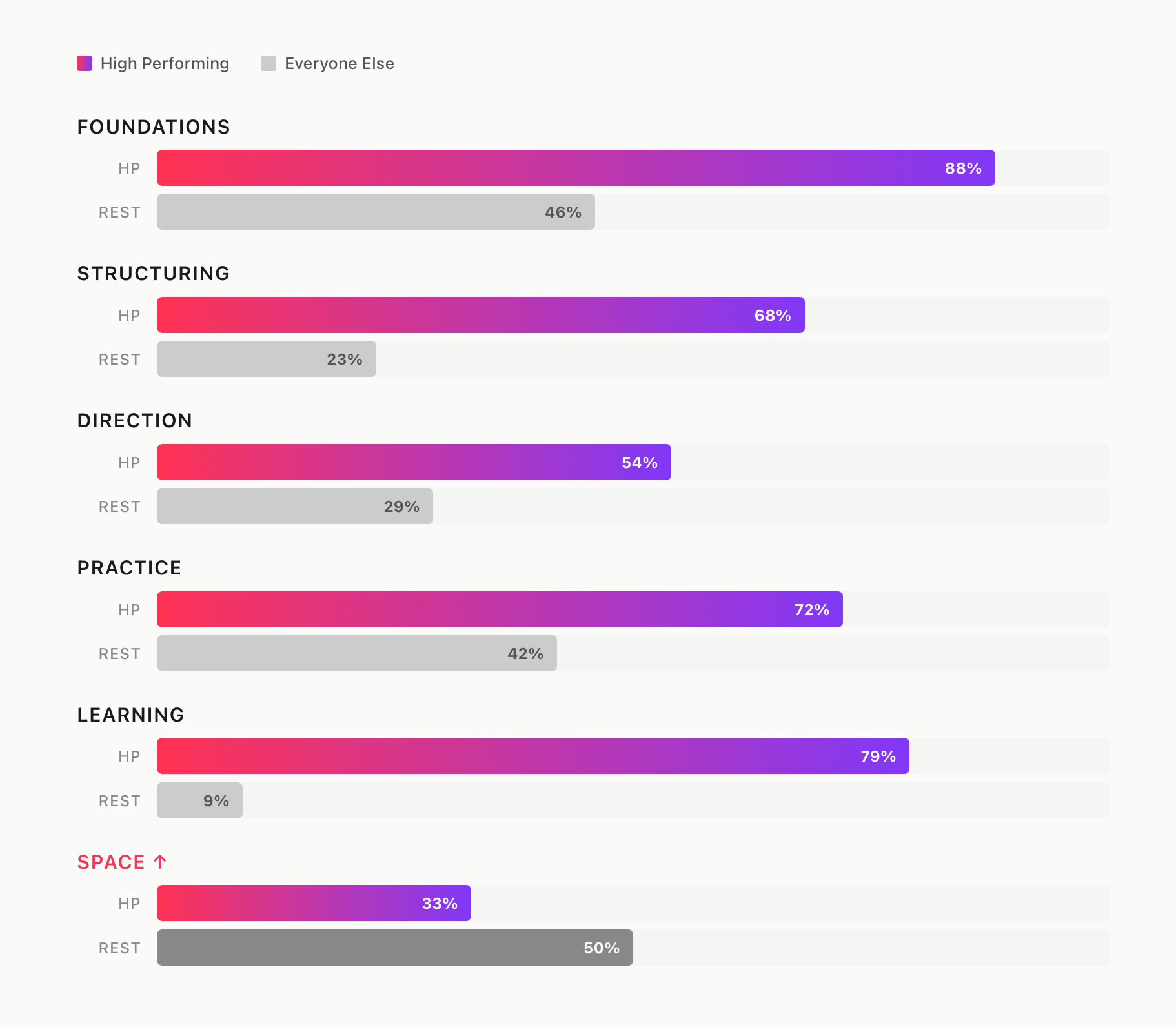
High Performing organizations agree with the pattern indicators at 2.1x the rate of everyone else. Agreement rate (4+ on a 5-point scale): High Performing = 65.7%, Everyone Else = 32.0%. With n = 17, this is suuuuper early and directional, not conclusive. But it's a wide gap for a first look.
Learning is the biggest differentiator. Patterns like Experimentation, Flow State Work, and Length Limit show a 70-percentage-point gap in agreement (79% High Performing vs. 9% Everyone Else).
The patterns come as a bundle. Foundations and Learning are tightly correlated at r = .79. Does this suggest it's the whole system or not much at all? I argue in the book that patterns reinforce each other, but I'll be surprised (perhaps not pleasantly) if this whole-system thing continues to play out.
The patterns that showed the strongest High Performance signal so far are a mix I find encouraging: Elections (+4.0 mean gap), Kanban (+4.0), Structural & Psychological Safety (+3.7), Do No Harm (+3.7), and Check In & Out (+3.3). Governance, visibility, daily practice, ah, the boring social technology of a well-run organization.
Honest caveats
Seventeen respondents across seven industries. Seven High Performers vs. ten Everyone Else. One block has zero High Performing respondents, so 15 patterns have no comparison data yet. Three of the seven High Performing respondents are from small consulting firms, which may self-select for these patterns. Self-report bias is real, so the same optimism that drives High Performing classification is probably inflating pattern agreement, but the prompts are behavioral, so...I'm not too worried about that.
If you work in an organization, take the survey. Give me five minutes. Send it to a friend. The more data I collect, the sharper every one of these signals gets, and I'll be turning this into a research report in a few weeks' time.