No matter what you do, the output is code
 Ethan Adams and Cai Charniga and Sachi Shah
Figma’s writeup about building nested folders is nominally about...nested folders. But like everything (let me tell you someday about my belief that all movies are kinda-sorta org design movies. Jason Bourne? Guy struggling with role clarity and bosses with different POVs, incentives), this is an OD/ways-of-working story.
About a year ago, they started the project normally: Product worked through requirements, Design mapped the experience, Engineering started building when the thinking felt resolved. Then code got cheap and accessible enough that they stopped waiting for the thinking to resolve.
Copy not perfect? No worries. Functionality lacking? That was alright. Logical gaps? We could fix those later!
Engineers put up PRs instead of continuing debates in Slack. Engineers made design calls. Their designer pushed code. The PM spent less time directing execution and more time with customers and on the broader product question. As someone who remembers when static marketing sites would cost companies millions of dollars and several external vendors to build, I'm still amazed that this is where we are.
Remember when a prototype—an embodied question—was a representation of a product, because building the actual product was expensive? The whole thing is a prototype now.
As in many stories I've heard directly from people working on these kinds of projects, the role stuff is still fairly normal. Cai Charniga, the designer, is pretty explicit that they did not suddenly become an engineer, and that knowing when to hand something back was part of the work. The boundaries just became much more permeable, and everyone got a bunch more permission. This is a nicer description of what may happen to role clarity than “everyone becomes a generalist.” People retain craft while being a lot less precious about jurisdiction.
Gusto went further
 Claire Vo
Around the same time, Gusto CTO Eddie Kim described how a team of four engineers and one designer built Gusto Cofounder in about ten weeks.
No dedicated PM. No Jira. No Figma. No specs. No standups or retros. They worked from a permanent Zoom room and built things directly, including things they expected to throw away. Gusto designer Katie Kovalcin has a good account of the same project from the design side.
I'm not sure that this is The New Product Development Model™. Five exceptional people working on a new product with support from the CTO is an unusual setup for a company with circa 4,000 employees and $1b in revenue.
Figma is doing this inside a fairly recognizable cross-functional team. Gusto basically took the walls off.
Cool!
More output, more mess
 Tom Critchlow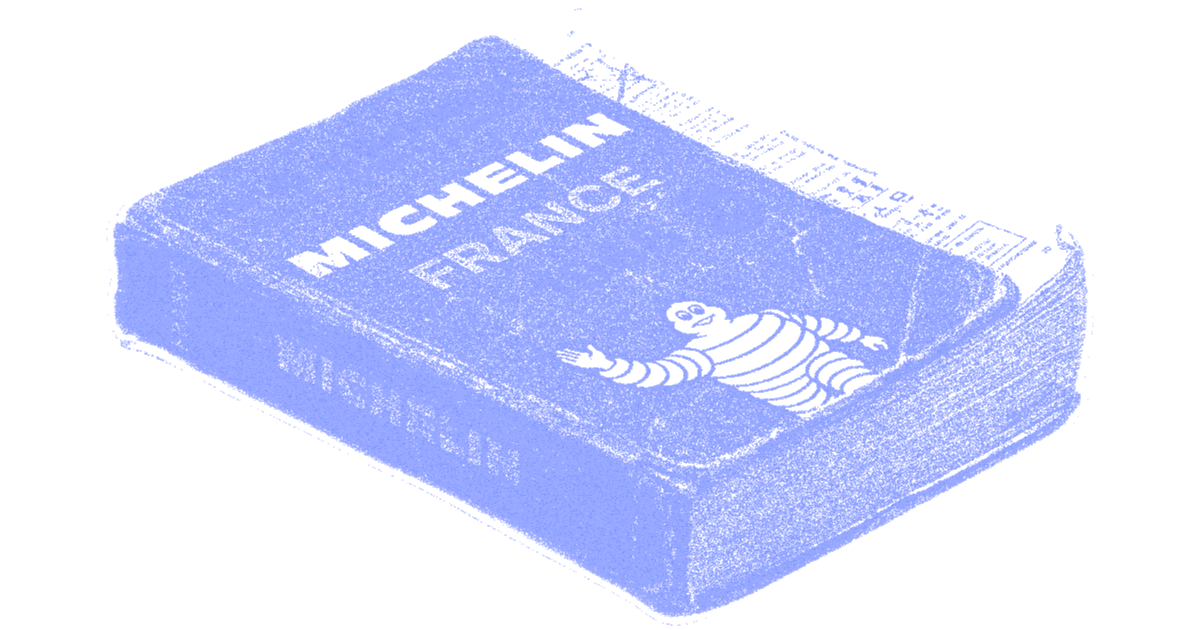
Tom Critchlow’s Almanac for the Age of Chaos is mostly about marketing (and many of you came here when this blog was about marketing, so, here's one for the old heads), but there’s a very good organization-design section in the middle.
AI increases individual throughput but so far it has not increased the organization’s capacity to coordinate at the same rate. The advent of terms like slop cannon, and Clay's (no relation) recent buzzy policy on AI writing would indicate that the opposite is happening. More drafts. More variants. More experiments. More work arriving for review. More things that look finished even though nobody has decided whether they are finished.
Tom's answer is context and traces. Slack threads, issue states, CRM fields, transcripts, approvals, customer notes, source trails. In a slower organization these can look like administrative residue. Once humans and agents can produce work much faster, they become the machinery by which everyone knows what is current, dead, approved, speculative, superseded, etc.
This is basically the problem a Logbook is trying to solve.
There’s an appealing fantasy where AI removes the coordination tax from organizations. Could also be that it removes the production constraint and we discover how much coordination tax we're paying. (NB: a lot.)
An argument for more people talking to each other
 Bright Simons
Bright Simons has an essay in The Ideas Letter called The Social Edge of Intelligence, and inside of it, he points to a study where researchers gave roughly 300 writers a short-fiction task. AI assistance improved the judged creativity of individual stories, but the AI-assisted stories became more similar to one another. Individual improvement, collective convergence.
The intelligence inside AI, such as it is, is partly an inheritance from the social systems that produced its training material: disagreement, institutions, different disciplines, apprenticeship, argument, accumulated tacit knowledge. If organizations automate away too much of that substrate, they can get locally more efficient while slowly impoverishing the collective wisdom on which they depend.
There are already some funny cross-currents in the evidence. Anthropic found people using Claude Code reporting fewer mentorship interactions and team touchpoints. A separate INSEAD field experiment found that giving workers AI actually increased human collaboration and knowledge-sharing ties.
I figure a year-ish from now we'll start seeing a lot more companies with customized or ground-up harnesses, reliance on open-weights or open-source models, etc. I also think that companies doing this well will focus much more on the social systems and even the safety nets/ladders they provide to each other.
Systems thinking has a family tree
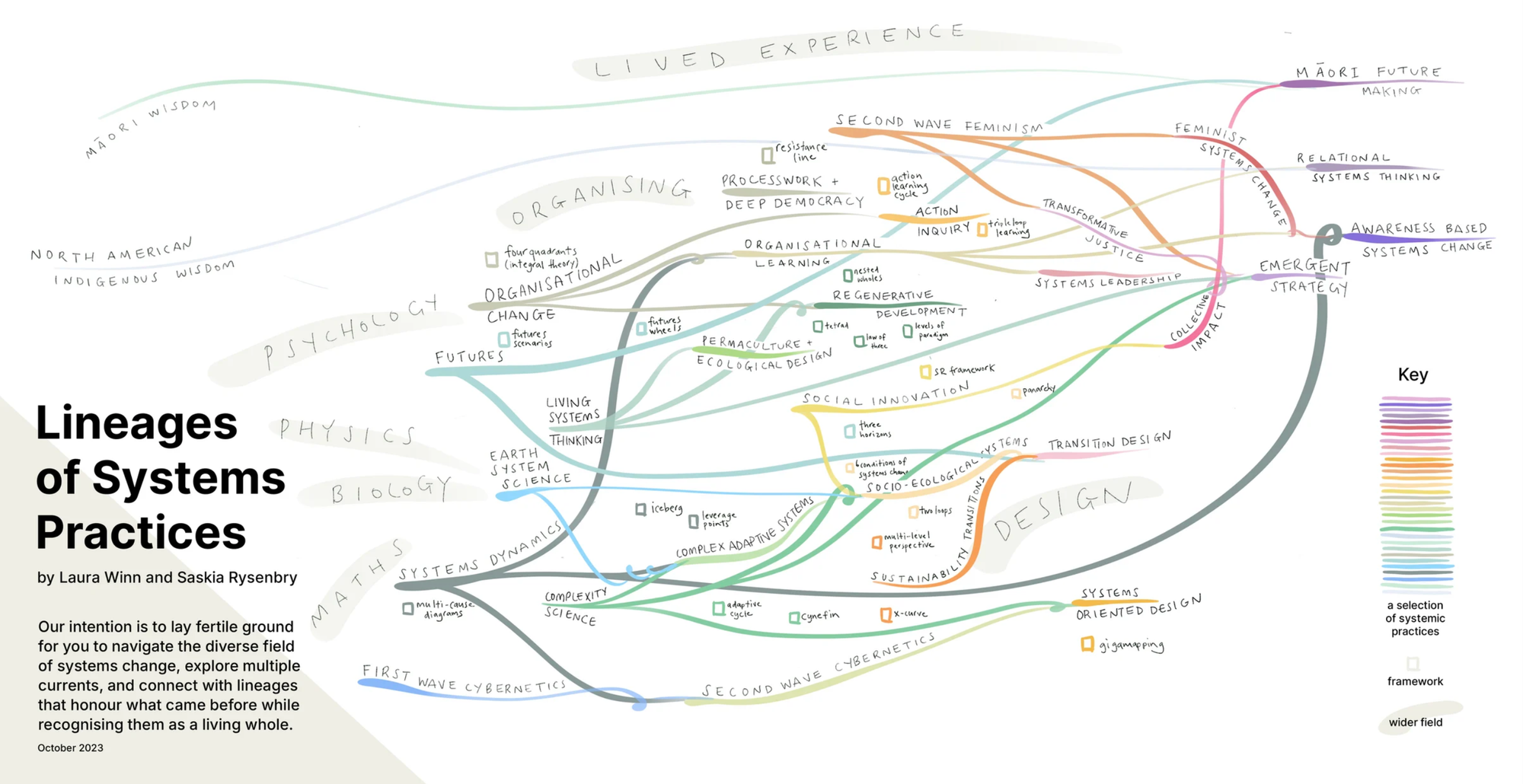
Laura Winn and Saskia Rysenbry at the School of System Change made a beautiful map of the lineages of systems practices: systems dynamics, complexity, cybernetics, indigenous practice, living systems, participatory traditions and a bunch of tributaries running between them.
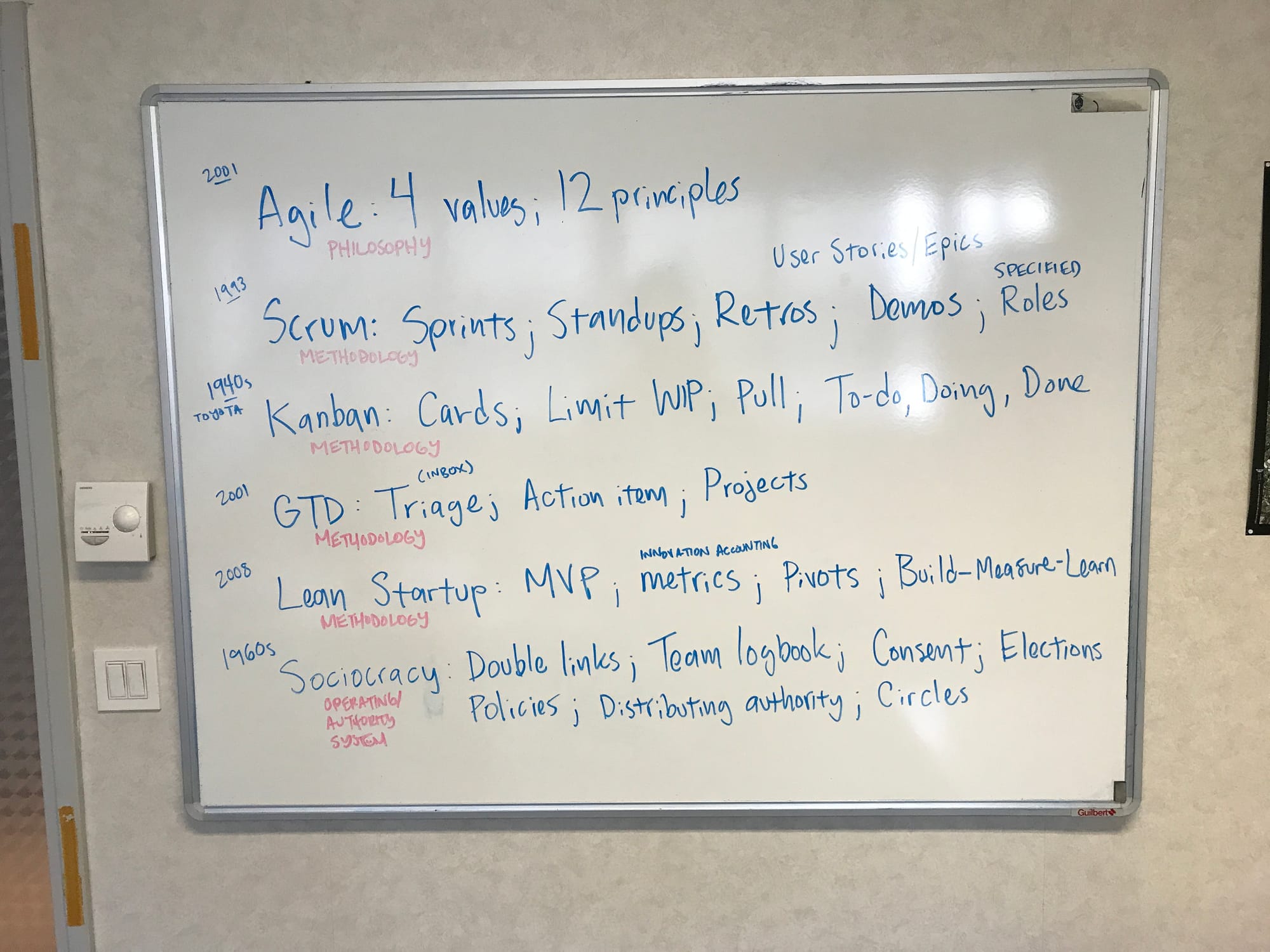
This reminds me of a thing that I drew to help on board folks to August. A method detached from the philosophy and history that produced it is weaker, and can even reproduce the thing it was designed to change.
(This is also where Two Camps—a new essay coming soon to an inbox near you! click that preview link!—is headed. There’s a structuralist tradition in org design, which says that structure shapes behavior. And a mutualist tradition, which says that people interacting together produce structure. We have a nasty habit of grabbing one and forgetting the other.)
There’s a lovely example in this old Marvin Weisbord paper.
After WWII, Ken Bamforth returned to a South Yorkshire coal mine and found miners reorganizing themselves around new mining technology. Instead of fragmented shifts with narrow jobs, they worked as multi-skilled teams that coordinated their own work. Waste fell, productivity rose and safety improved. Eric Trist visited, and the observation became foundational to socio-technical systems design. Then consultants got ahold of it.
Decades later Weisbord encountered companies installing a standardized “multi-skilled work team model.” People resisted it. The participative practice had become a thing done to them.
This is an extremely funny thing to read in 2026.
Figma’s engineers making design calls, Gusto’s designer shipping production code, teams figuring out how to work with agents...this is all about how the technology changes, and how people reorganize the work around it. Then somebody notices, calls it a model, makes a framework, and rolls it out to 40,000 people.
Maybe don’t do that this time.