If you've ever been reorg'd and thought "this is bullshit," guess what? You were probably right.
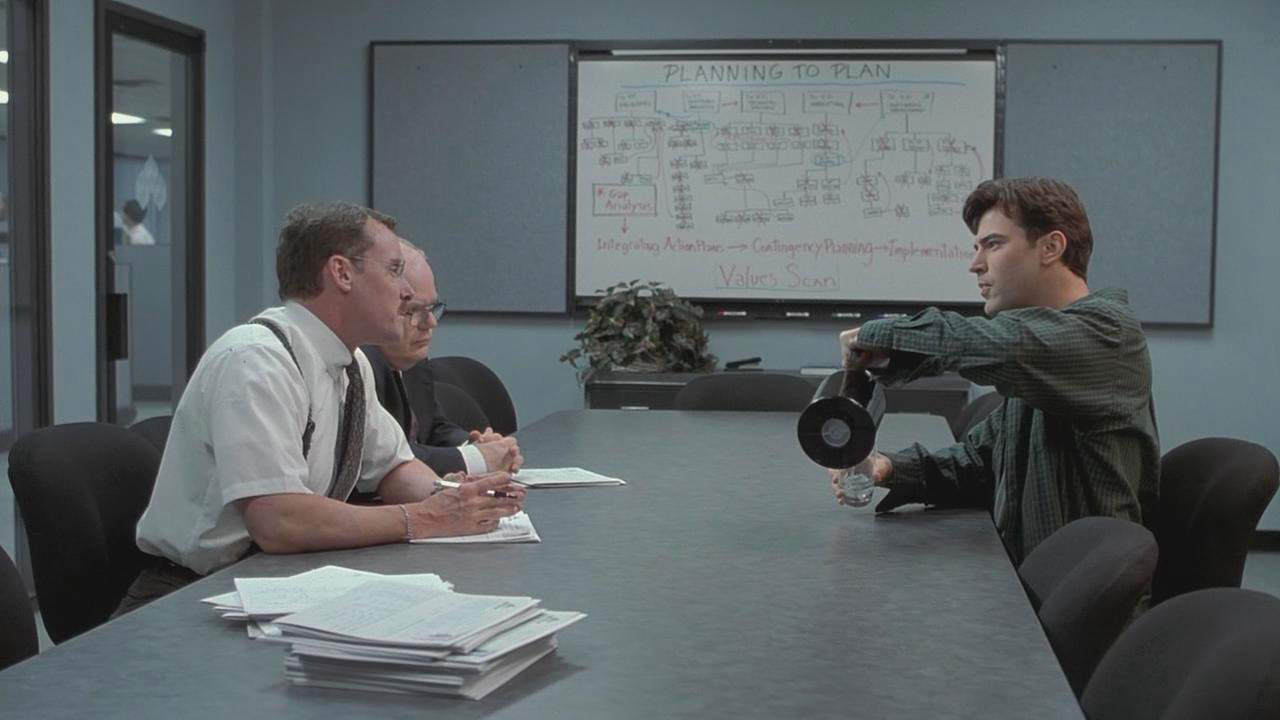
In a 2013 McKinsey survey of 2,063 executives, 1,534 had experienced a redesign at their current organization. Among respondents personally involved in one, 21% said the new structure had been fully implemented, met its initial objectives very or extremely well, and improved performance.[1]
That does not mean that the remaining 79% are a dumpster fire. Still: only 21% cleared all three bars. That is bad! Especially for something that absorbs months of senior attention, a lot of consulting fees, and an otherworldly quantity of PowerPoint slides.
The challenge is that the market for organization design has split one problem set into separate practices. One group gets hired to design the formal organization: reporting lines, roles, decision rights, resources, governance. Another gets hired to work on the lived organization: trust, habits, informal networks, conflict, participation, and how work actually gets done. The first usually has a clear executive sponsor and a transformation budget. The second often follows the first one's design work, and helps it actually work, but at a lower rate with lighter formal endorsement.
Two questions:
- What is being designed? Formal architecture or lived behavior and informal organization?
- Who gets to design it? A concentrated group with positional authority or a broader group of people who do the work?
A conventional reorg combines formal architecture with concentrated authorship. A centrally sponsored culture program works on behavior with the same concentrated authorship. Sociocracy pays serious attention to participation and distributes a great deal of operating authority. Holacracy is an extremely formal architecture built to distribute authority. Buurtzorg uses deliberate formal constraints to support local autonomy.
So “structuralist” and “mutualist,” the terms I'll use here, are bundles rather than settled academic schools. Structuralists tend to favor formal architecture and concentrated authorship. Mutualists tend to favor lived behavior and distributed authorship. Tend to.
- Every structural intervention has behavioral consequences.
- Every participatory process operates inside a formal distribution of power.
You cannot redraw reporting lines without changing status, identity, attention, and who talks to whom. You also cannot invite everyone into a circle and pretend away the CEO's authority to set budgets, hire and fire, appoint leaders, or end the exercise. Participation can influence power. It is not automatically power.
I've spent my career in the gap between these two traditions.[2] I co-founded August after coming up through Undercurrent, where we practiced participation-first organization design on ourselves and with clients (I wrote about how Undercurrent worked in “Open Undercurrent”). More recently, at R/GA, Black Glass, and Airbnb, I have led structure-first work with executive sponsors, design criteria, and the kinds of artifacts that get real budgets. I've watched the two traditions work on the same organization without realizing they were working on the same thing. I have also been part of the problem. Sometimes the budget ran out. Other times we could not sell the other half of the work.
McKinsey & Company, “The Secrets of Successful Organizational Redesigns: McKinsey Global Survey Results” (July 2014). The online survey ran September 10–20, 2013. McKinsey defined success as a structure that respondents said was fully implemented, met its initial objectives very or extremely well, and produced a significant or moderate improvement in overall performance. ↩︎
My book Hidden Patterns sits between these traditions. HAHA! Promotion! Please buy it. ↩︎
The Structuralist Tradition

Anyone who has watched an org chart get unveiled in a town hall, sat through a deck on spans and layers, or endured a reorg announcement promising clarity and accountability has experienced structuralism in practice. It is the part of organization design that buyers already know how to buy. It produces a scope, a steering committee, a model, and eventually some boxes.
Someone has to draw the boxes! In commercial practice, though, formal design usually comes with concentrated authorship, while the social organization gets pushed into implementation.
Strategy → Structure
Alfred Chandler's 1962 book Strategy and Structure examined DuPont, General Motors, Standard Oil of New Jersey, and Sears. Its famous argument was that the administrative structures of large firms changed in response to strategic expansion and diversification.[1] In practice, “structure follows strategy” became a pleasing (and powerful!) sequence: executives choose a direction, then design an organization to execute it.
That sequence made structure into a lever for strategy. It also put authorship at the top. At that point—and in many organizations today—the strategy belonged to senior leaders; the structure followed; everybody else heard the story during implementation.
Structure as information processing
Jay Galbraith made Chandler's research more useful. His information-processing view starts with uncertainty: the more uncertainty a task contains, the more information an organization must process while doing it. Organizations can reduce the need for information through excess/slack resources or more self-contained tasks, or increase their capacity to process information through lateral relationships and better information systems.[2]
An org chart is a theory about information. Put two teams under one leader and you are betting that coordination through that leader will help, that the new relationships created will yield better decisions. Create a cross-functional unit and you are betting that colocating interdependent work will reduce the cost of passing information across boundaries. Add a matrix and you are betting that the value of another channel exceeds the meetings it will spawn. (Sometimes a terrible bet.)
Galbraith's later Star Model connected strategy, structure, processes, rewards, and people, making clear that structure ≠ boxes and lines.[3] In commercial practice, though, the boxes and lines remain seductively legible. The formal artifacts win partly because buyers can see them and consultants can produce them. Structural diagnosis can be presented to an executive committee, but informal trust, workarounds, and the person everybody calls when something breaks are harder to fit on a slide and frequently cut because the Partners rightfully know their clients don't have time or attention for it.
The contemporary practice
In Designing Your Organization, co-authored with Galbraith, Amy Kates details a process that begins with strategy, develops design criteria, compares options, and carries choices into detailed design and implementation. Kates co-founded Kates Kesler, which Accenture acquired in 2020.
I actively use a version of this process, and it works very well. Clear design criteria beat executive whim. Explicit options expose tradeoffs. Decision rights, accountabilities, and resource flows need to be designed, often precisely; large organizations cannot indefinitely facilitate their way toward these answers.
The top team is usually the client. The organization is the thing being designed. People with detailed knowledge of the work may be consulted, interviewed, or placed on a design team, but senior leaders in general retain authorship and approval.[4]
The bridge to nowhere
In 1951, Eric Trist and Ken Bamforth published their study of work in Britain's newly nationalized coal industry, then run by the National Coal Board.[5] Mechanized longwall mining had improved the technical system while breaking apart the cohesive work groups that had organized the older method. Trist and Bamforth contrasted that arrangement with a “composite” group that rotated tasks and took collective responsibility for a full production cycle.[6]
That became sociotechnical systems theory and, later, the language of joint optimization. Technology changes interdependence, and interdependence changes the information people need, the relationships they form, and the authority required to handle exceptions. Optimizing the machine while treating the crew as interchangeable labor can make the whole system worse.
As I started writing this essay, I thought I had found a genuinely novel synthesis. NOPE. Trist and Bamforth were already there in 1951. (As I tell my team often, being right is rarely a requirement in this field.)
The work did not instantly change British mining. Enid Mumford's later history describes a mixed reception: composite group work conflicted with wage bargaining organized around traditional jobs, while the Coal Board was reluctant to provoke a union dispute.[7] Sociotechnical thinking spread elsewhere. The commercial market I know still tends to split the problem back apart: structure first; relationships, informal authority, and behavior later, as “change impacts” or implementation.
Alfred D. Chandler Jr., Strategy and Structure: Chapters in the History of the Industrial Enterprise (MIT Press, 1962); Harvard Business School, “Remembering Alfred Chandler” (2007). ↩︎
Jay R. Galbraith, “Organization Design: An Information Processing View”, Interfaces 4, no. 3 (1974), pp. 28–36. ↩︎
Jay R. Galbraith, Organization Design (Addison-Wesley, 1977); Galbraith Management Consultants, “Star Model”. Later versions explicitly put behavior, performance, and culture beneath the star—a useful acknowledgment, depicted rather unfortunately as the excrement of the model. ↩︎
I have literally had this discussion with former consulting partners. Their question: “What is the client holding at the end of the engagement?” My response: “They're holding RESULTS.” It is hard to sell results unless you are MBB; everyone else has to sell deliverables. ↩︎
UK Parliament, “Coal Industry Nationalisation Act 1946” and The National Archives, “The National Coal Board”. ↩︎
E. L. Trist and K. W. Bamforth, “Some Social and Psychological Consequences of the Longwall Method of Coal-Getting”, Human Relations 4, no. 1 (1951), pp. 3–38. ↩︎
Enid Mumford, “The Story of Socio-Technical Design: Reflections on Its Successes, Failures and Potential”, Information Systems Journal 16, no. 4 (2006), pp. 317–342. This is a later historical account, not evidence from the original mine study. ↩︎
The Mutualist Tradition
Kerala sardine prices · Before and after cell phones
Across five beach markets in each of three Kerala regions, Jensen reported that price dispersion and waste fell after mobile coverage reached the fleet.
Between 1997 and 2001, economist Robert Jensen studied the staggered arrival of mobile-phone coverage in fishing regions of Kerala, India. Before coverage, boats sometimes returned to a crowded market and dumped unsold sardines while buyers elsewhere faced shortages. Jensen found that price dispersion and waste fell as coverage grew, and he attributed the pattern to fishermen comparing prices while still at sea; his estimates also showed higher fishermen's profits and lower consumer prices.[1] In his account, the technology moved information and choice toward the people deciding where to sell fish.
I call the alternative tradition mutualist. Sociocracy, self-management, participatory facilitation, culture work, and informal-network analysis have different histories and sometimes incompatible commitments. The thing that connects these practices is a shared orientation to start with relationships and local knowledge, involve the people affected in authoring the organization, treat structure as something that can evolve through use...and leave the people with the tools necessary to make it better on purpose.
Classic Organization Development fits in here, too. Lewin's action research tied inquiry to action. Schein's process consultation made the client part of diagnosis and remedy instead of treating a consultant as an outside expert who could simply install an answer.[2]
Participation is more than what happens when the “real” designers leave and somebody orders Post-its.
Sociocracy: Ward → Boeke → Endenburg
Auguste Comte coined the term "sociocracy" in the nineteenth century; Lester Frank Ward later used it for a scientifically guided social order. The participatory meaning came later through Dutch educator Kees Boeke and his wife, Beatrice “Betty” Cadbury (yes, that Cadbury family). They founded the Werkplaats school community in Bilthoven in 1926 and used a form of consent governance. Boeke opposed majority rule because a durable minority could be repeatedly overruled; his alternative was to proceed when no participant had a reasoned objection they regarded as paramount.[3]
Gerard Endenburg, who had attended Boeke's school, adapted those ideas for an electrical-engineering company. The Sociocratic Circle Organization Method added nested circles, consent-based policy decisions, elected roles, and double-linking between levels.[4] Holacracy is a weirder idea, with connections to Ken Wilber, integral theory, and libertarianism. Its constitution specifies roles, domains, accountabilities, governance meetings, and rules for changing the rules.[5] You may find the language cultish—I often do—but you cannot call it informal.
At a Holacracy training in 2014, Jordan, my then-colleague at Undercurrent, and I met a participant who had been to EIGHT not-very-inexpensive trainings and had never really implemented any of it at work. The ridiculous formalism that makes it so hard to learn gave us a way to bring a conversation about self-management into boardrooms where it would not otherwise have reached. It made it legible.
The practice I came from
I learned this orientation at Undercurrent, a kinda-sorta management consultancy in the early 2010s, and then co-founded August with four friends from UC. In both companies, we experimented on ourselves: distributed authority, transparent information, explicit decision practices, new meeting forms. We also helped clients work differently. Some of it was excellent. Some of it was very earnest. We were not always great at telling the difference.
Undercurrent closed suddenly on July 31, 2015, a few months after Quirky acquired it. Mike wrote that “What would you do if you could start all over with a blank slate?” went from philosophical to very, very real overnight. August was one answer. Undercurrent's people went on to help build The Ready, NOBL, Kindred, and other firms. The Responsive.org manifesto, authored by UCers and friends, put out a call to action that still resonates today: Purpose over profit; Networks over hierarchies; Empowering over controlling; Experimentation over planning; Transparency over privacy.
But participation has its own bullshit.
First, consent can become theater. If the CEO can set the budget, remove the facilitator, hire and fire the team, appoint senior leaders, or end the experiment, everybody in the circle knows it. Distributed operating authority can be real and valuable while ownership and governance remain completely conventional. Say which power is moving.
Frederic Laloux gets pretty bleak about this at the end of Reinventing Organizations. In his account, BSO/Origin's self-managing system reverted after the company was sold to Philips and the new board restored conventional management. His two necessary conditions for a real transformation: the CEO has to want it, and the board has to agree.[6]
Second, participation can conceal power. Jo Freeman's “The Tyranny of Structurelessness” made the point bluntly: refusing formal structure does not remove elites; it makes them less accountable.[7]
Third, emergence does not settle enterprise tradeoffs by magic. Local teams can optimize their own work while shifting costs onto another team, duplicating capability, or starving shared infrastructure. “Let the team decide” is not an answer until we know which team, about what, within which constraints, and who is in trouble when something goes wrong.
Anyway. I have walked into rooms with executive teams and focused on facilitation when what they needed was someone to draw the boxes. I have prioritized buy-in over clarity and watched the ambiguity I preserved become its own kind of dysfunction. I have treated emergence as morally cleaner than design, even when the ambiguity protected existing power.
Robert Jensen, “The Digital Provide: Information (Technology), Market Performance, and Welfare in the South Indian Fisheries Sector”, Quarterly Journal of Economics 122, no. 3 (2007), pp. 879–924. Jensen studied 15 beach markets in three regions of Kerala and the staggered introduction of mobile coverage. The paper reports reduced price dispersion and waste, an 8% increase in fishermen's profits, and a 4% decline in consumer prices. The study exploits staggered rollout and comparison groups but is not a randomized experiment. Later ethnographic work found more varied phone uses among different actors and warned against generalizing Jensen's proposed mechanism: Janaki Srinivasan and Jenna Burrell, “On the Importance of Price Information to Fishers and to Economists”, Information Technologies & International Development 11, no. 1 (2015), pp. 57–70. ↩︎
Kurt Lewin, “Action Research and Minority Problems”, Journal of Social Issues 2, no. 4 (1946), pp. 34–46; Edgar H. Schein, Process Consultation: Its Role in Organization Development (Addison-Wesley, 1969). ↩︎
Kees Boeke, “Sociocracy: Democracy as It Might Be” (English edition, 1945); Werkplaats Kindergemeenschap, “Kees en Betty”; Sociocratisch Centrum Nederland, “Ontstaansgeschiedenis” (history of the method's development). ↩︎
Gerard Endenburg, Sociocracy as Social Design (Eburon, 1998 English edition); Sociocratisch Centrum Nederland, history of the Sociocratic Circle Organization Method. ↩︎
HolacracyOne, Holacracy Constitution, version 5.0 (2021). ↩︎
Ben Linders, “Q&A with Frederic Laloux on Reinventing Organizations” (InfoQ, 2014). Laloux describes BSO/Origin's reversion after its sale to Philips and calls CEO and board alignment the two necessary conditions. ↩︎
Jo Freeman, “The Tyranny of Structurelessness”, originally presented in 1970 and published in 1972. ↩︎
Synthesis: The Integrated Practice
In practice, these traditions usually meet in sequence. Structural designers produce the target operating model. Change and culture people arrive afterward to communicate it, gather feedback, and help it land. Sometimes the handoff is reversed: participatory practitioners facilitate discovery for months, then call a structural specialist when the client finally asks who reports to whom.
An integrated engagement keeps both forms of evidence in the same diagnosis and at the same decision table: reporting lines, roles, resource flows, decision rights, incentives, governance, informal networks, practical knowledge, trust, conflict, identity, and how the work already gets done. One person can hold all of that. A tightly coupled team can, too. Everybody at the table needs enough fluency to challenge everybody else.
We have some examples that refuse the mapping of structure to concentrated authorship, of autonomy to informality.
Buurtzorg is usually told as a story about removing managers from home care. Their Dutch nursing teams are small—generally no more than twelve nurses—and take responsibility for a defined neighborhood and patient group. Teams plan care, divide roles, manage schedules, and coordinate with other providers. Regional coaches advise multiple teams but do not act as line managers. A small central organization handles functions such as payroll and contracting. BuurtzorgWeb gives teams a common information and communication system.[1] The autonomy here is heavily designed. Team size, geography, information infrastructure, coaching, shared services, and the scope of local authority are all choices someone made. The nurses then have substantial freedom inside them.
And in spite of it flying in the face of management orthodoxy—even while making complete sense to every nurse I've ever discussed it with—it works very, very well. A KPMG case-mix-adjusted analysis cited by the Commonwealth Fund found fewer home-care hours and lower home-care costs in 2013. When physician, hospital, and nursing-home costs were included, total cost per client was about average.[2]
Under RenDanHeYi, Haier describes the enterprise as a network of customer-facing microenterprises connected to internal platforms and shared services. Its company materials describe microenterprises as the basic unit in a flat or grid organization and assign them rights over management, people, and distribution, along with responsibility for results.[3] A microenterprise may control product decisions, hiring, and compensation within its domain while operating inside a listed corporation with a conventional board, shareholders, and senior appointments. Haier Smart Home, the group's publicly listed appliance business, reported 2025 revenue of RMB 302.33 billion and 134,995 employees at year end.[4]
Again, distributed authority sits inside a lot of architecture: defined microenterprises, internal markets and platforms, rights over people and compensation, and conventional corporate governance around the whole thing. So yes, this combination works at enormous scale.
A practical standard
Here is a test. An integrated engagement should make four things explicit:
- The formal system being changed. Roles, reporting relationships, decision rights, resources, incentives, governance, ownership constraints, and the technical interdependencies of the work.
- The lived system already doing the work. Informal networks, practical routines, workarounds, trust, conflict, status, and where decisions actually happen.
- The conflicts between them. Places where the formal process blocks necessary behavior, where the informal system defeats legitimate controls, or where each side is compensating for a failure in the other.
- The evidence that will show whether the design works. Outcomes, decision quality and speed, coordination load, employee and customer experience, and unintended shifts in power or risk.
Start with the work and its interdependencies, not the current chart or a blank canvas. Map how information reaches decisions and where exceptions travel. Compare formal authority with authority-in-use. Bring people with local knowledge into diagnosis and option testing, while naming which decisions are consultative, delegated, consent-based, or reserved. Test structural options against behavioral evidence; test participatory proposals against budget, governance, and accountability. Repeat before anybody unveils anything in a town hall.
The space between drawing the boxes and bottom-upping the answer is a negotiation. People inside the organization often cannot conduct it cleanly; they are living inside the authority, incentives, and risk preferences being negotiated. That is one reason outsiders are useful. Participation cannot solve a mismatch between the risk the organization must carry and the risk its people are willing to carry. Sometimes the constraint is real, and sometimes the answer should come from the top. — Shoutout to Jordan for prompting this quick aside
Concentrated authority can be legitimate. A board may reserve the right to appoint a CEO. A leader may set a budget. A regulator may impose a control. Integrated design asks that we consider these facts rather than hide them behind the word “stakeholder.”
Where do the consequences go?
Who bears the downside if a local team makes a bad call?
Who receives the surplus if it makes a good one?
Who can reverse the decision?
Who can remove the decision-maker?
Sharda S. Nandram, Organizational Innovation by Integrating Simplification: Learning from Buurtzorg Nederland (Springer, 2015); Buurtzorg, “The Buurtzorg Model”. Team counts and staffing change over time, so the essay avoids presenting a current total as a fixed feature of the model. ↩︎
The Commonwealth Fund, “Home Care by Self-Governing Nursing Teams: The Netherlands' Buurtzorg Model” (2015), reports the KPMG comparison and its limits. The underlying report did not fully describe Buurtzorg's patient mix. Rianne Maurits et al., “Home-Care Nursing Staff in Self-Directed Teams Are More Satisfied with Their Job and Feel They Have More Autonomy over Patient Care”, Journal of Advanced Nursing 73, no. 10 (2017), pp. 2430–2440, is a cross-sectional staff survey, not a causal test of Buurtzorg. ↩︎
Gary Hamel and Michele Zanini, “The End of Bureaucracy”, Harvard Business Review (November–December 2018); Haier Group, “Corporate Culture” and 2019 Corporate Social Responsibility Report. These are descriptive company and practitioner accounts, not causal evaluations. ↩︎
Haier Smart Home Co., Ltd., Annual Report 2025, pp. 68 and 79. Revenue and employment refer to Haier Smart Home, not necessarily every entity in Haier Group. The figures do not establish that RenDanHeYi caused financial performance, that every employee works inside the model in the same way, or that another company can reproduce the results by copying microenterprises. ↩︎
Management fads · 1950–2000
Richard Pascale’s streamgraph of business bullshit, re-digitized from the original chart. A fun fact about Pascale is that he was one of the original authors of McKinsey's 7S model.
Why the Split Persists
Marvin Weisbord's 1976 Six-Box Model asked practitioners to examine purposes, structure, relationships, rewards, leadership, and helpful mechanisms, including the fit between the formal system and what people actually do. David Nadler and Michael Tushman's 1980 Congruence Model treated work, people, formal organization, and informal organization as interdependent components.[1]
And...training follows professional identity. Structural designers learn strategy, work decomposition, operating models, and governance. Organization Development practitioners learn groups, participation, conflict, and change. Budgets follow procurement categories. A formal redesign produces legible artifacts quickly; a serious informal diagnosis traditionally requires interviews, observation, workshops, and time.
What computation changes
Spans, layers, reporting lines, role inventories, and policy documents have long been relatively cheap to analyze because the data are already structured. Informal organization has been expensive to measure and design because the useful evidence is dispersed across interviews, observation, stories, communication patterns, and exceptions. Modern language models and network-analysis tools can help code interviews, compare role descriptions, trace decision paths, find contradictory policies, and generate hypotheses from a larger body of qualitative material than one team could read unaided.
This will change the price and speed of assembling evidence, and it will tempt the impatient to use an LLM as an organization designer. This will miss the judgment to test patterns against context, politics, and lived experience.
In my experience so far, the most valuable computational output is usually a question, like:
- This team appears central to three workflows but owns no corresponding decision right. Why?
- The org chart says one function approves the work; interviews describe four different approval paths. Which one operates under pressure?
- Two groups have nearly identical role descriptions and very different reputations. What explains the difference?
- A redesign moved authority on paper, but escalation patterns did not change. Is the new authority understood, trusted, or real?
The surveillance issue
The same tools can become workplace surveillance with impressive speed.
Slack, email, calendar, meeting, and badge data reveal selected, digitally visible traces of the informal organization. They miss phone calls, private chats, friendship, avoidance, shop-floor interaction, and all the work done outside the chosen systems. They can overstate the importance of people whose jobs generate messages, understate expertise, and confuse frequent contact with trust or influence.
Analysis also changes behavior when employees reasonably believe it may be used to rank them, evaluate performance, or identify dissent. Consultants can extract, misclassify, and expose people in interviews and workshops, too. Computation can now do that across much more of the organization, much faster.
The formal organization has always been easier for management to see. But a technically clever network map can destroy the trust it claims to measure.
Onward. Where?
Trist and Bamforth had the basic answer in 1951. The technical system and the social system are one design problem. We spent the next 75 years unbundling the practice, to the detriment of organizations, teams, and people everywhere: structure over here, behavior over there; executives working on one, everybody else living in the other.
Earlier this year, Nicole Abi-Esber, Lindred Greer and Annebel De Hoogh have evidence for the next bit.[2] They call it hierarchical adaptability: a team's ability to repeatedly change the shape of its influence hierarchy as the work changes, becoming flatter or more hierarchical while the formal hierarchy stays put. In their experiment, adaptable teams coordinated and performed better than teams that stayed hierarchical or stayed flat.
The challenge for our field: how do we give teams the capacity to keep how they organize aligned with changing conditions. The adaptation happens in the team itself.
Further reading
To understand formal architecture and information processing:
- Jay Galbraith, Designing Complex Organizations (1973).
- Amy Kates and Jay Galbraith, Designing Your Organization (2007).
- David Nadler and Michael Tushman, “A Model for Diagnosing Organizational Behavior” (1980).
To understand participation, informal power, and distributed authority:
- Jo Freeman, “The Tyranny of Structurelessness” (1972).
- Aaron Dignan, Brave New Work (2019).
- Sociocracy 3.0 patterns (continuously updated).
To hold both systems together:
- Eric Trist, “The Evolution of Socio-Technical Systems” (1981).
- Marvin Weisbord, “Organizational Diagnosis: Six Places to Look for Trouble with or Without a Theory” (1976).
Marvin R. Weisbord, “Organizational Diagnosis: Six Places to Look for Trouble with or Without a Theory”, Group & Organization Studies 1, no. 4 (1976), pp. 430–447; David A. Nadler and Michael L. Tushman, “A Model for Diagnosing Organizational Behavior”, Organizational Dynamics 9, no. 2 (1980), pp. 35–51. ↩︎
Abi-Esber, Greer, L. L. & De Hoogh, A. H. B. (2026). Team hierarchical adaptability: benefits for team coordination and performance. Academy of Management Journal, 69(3), 563 - 592. ↩︎