In Our Time's "The Evolution of Trees" episode is excellent, and describes trees less as a botanical family and more as a recurring strategy in nature.[1]
Over millennia, many different plants arrived independently at the same basic form: a persistent trunk, a canopy of branches, and internal structures providing strength to hold the whole thing upright. Height provides access to light. Long-lasting structures create more opportunities to reproduce. Raised canopies help pollen and seeds travel. The advantages to this form drove plants toward tree-shaped-ness.
Is hierarchy the same?
It’s tempting to think of hierarchy as an historical artifact, a leftover from the military, church, railroads, or Frederick Winslow Taylor. Remove the industrial-era assumptions, the argument goes, and the pyramid should disappear with them.
It does not.
Cooperatives develop governing bodies. Startups acquire management layers. Self-managing organizations invent nested circles, lead links, delegates and constitutions. Movements suspicious of authority eventually discover spokespeople, committees and people who control the mailing list.
We do this because branching authority solves recurring problems. It lets an organization divide a large purpose into smaller ones, allocate resources across distance and maintain some coherence as the number of participants grows.
This does not make every hierarchy good. Evolution produces workable forms, not morally admirable ones. It does suggest to me that abolishing tree-shaped structures is unlikely to be a complete theory of organization.
The point of this article, though, is not to big-up the hierarchy. The story of the evolution of trees points to something even more useful: where growth is allowed to begin.
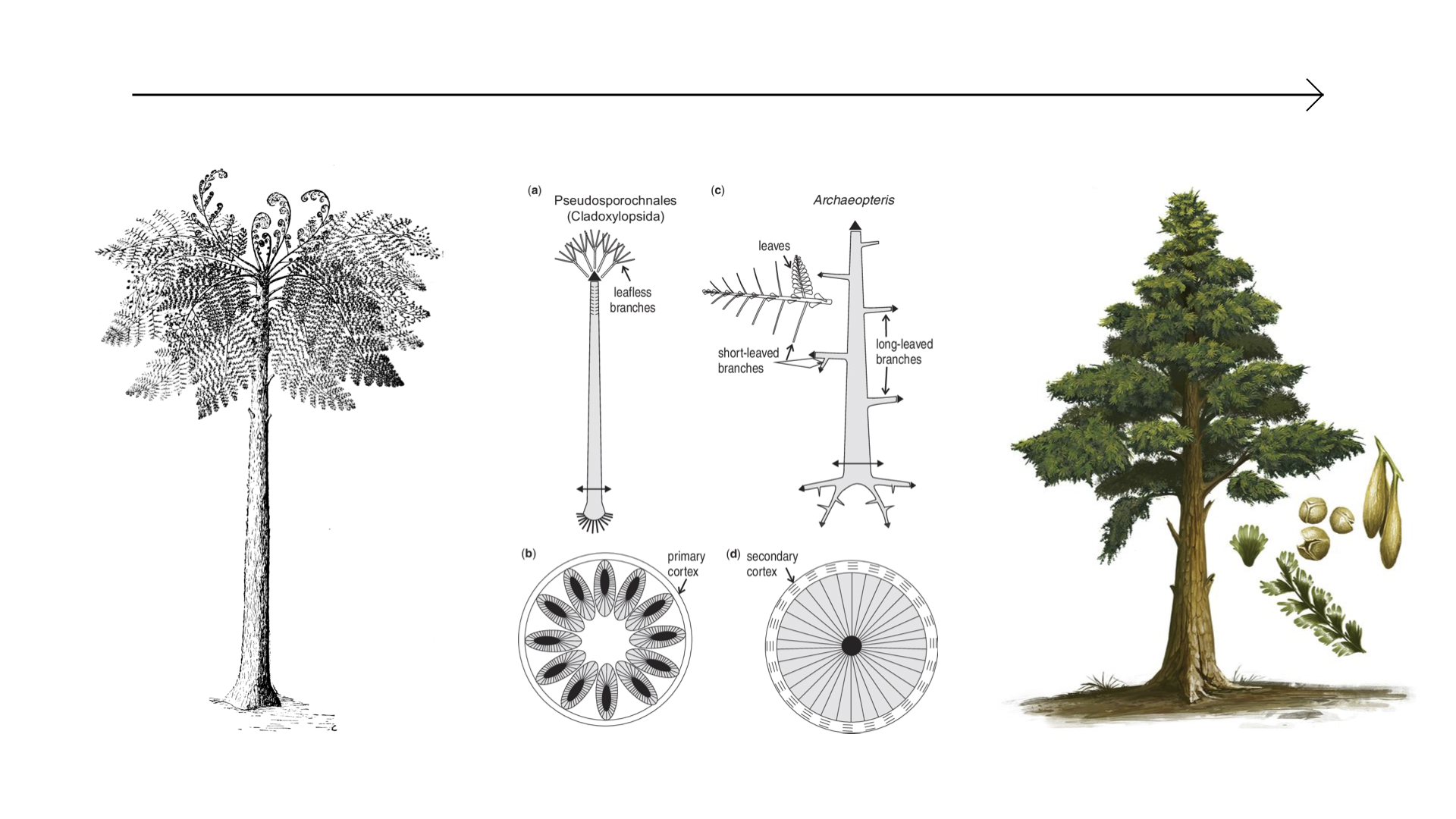
In some early trees, the body plan was directed from a growing point at the apex of the trunk. That point determined where branches appeared and how the organism developed. The arrangement could produce an impressively tall plant. It was also vulnerable. Damage the apex and the organism’s main source of new growth disappeared.
Later, Archaeopteris developed another capability. New branches could emerge from the surface of the existing trunk rather than only from the top. Those branches could become large and long-lived; some could even form a new trunk. The tree retained its vertical structure, but its ability to adapt was no longer concentrated in a single place. It became harder to kill and survived as a genus for roughly 25m years.
Most corporate hierarchies still behave more like the earlier tree.
They centralize authority. They also centralize opportunities for new growth. A new team, product, market or way of working generally requires sponsorship from somewhere above it. Local units may detect a change in the environment first, but sensing it and acting on it are separate rights. The branch can notice that the light has moved. Only the apex may reposition the tree.
This is where networks become useful. They create more places from which information, initiative and new growth can begin.
We should replace the idea of “hierarchy vs. network” with "one center of growth vs. many."
I have taken to listening to this podcast while feeding my now 3-month-old son, and it's the perfectly nerdy + meditative. Also: Hi! I’ve been on paternity leave! ↩︎