Alphabet is splitting scientific leadership from daily management at Google DeepMind.
Demis Hassabis will become Alphabet’s chief scientist and chairman of DeepMind, concentrating on long-term research, artificial general intelligence and its consequences. Koray Kavukcuoglu will run DeepMind as a senior vice president while retaining his role as Alphabet’s chief AI architect and reporting to Sundar Pichai.
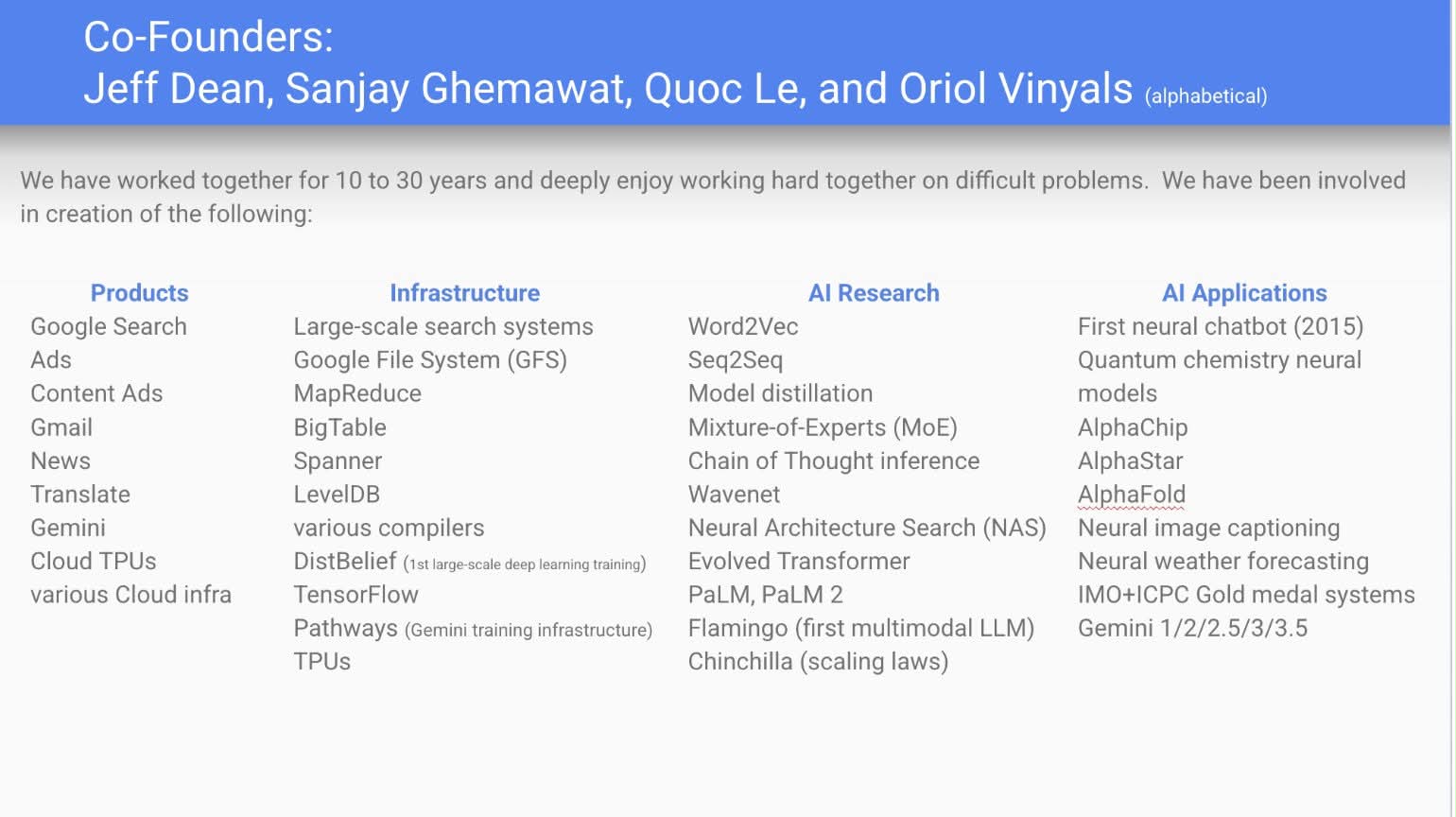
The change comes as Jeff Dean, Sanjay Ghemawat, Oriol Vinyals and Quoc Le leave to establish Google-backed Discovery Loop, a public-benefit company focused on AI-assisted scientific work. Google's next flagship Gemini model has also been delayed, and Alphabet shares fell about 4% on the announcement.
The Financial Times interprets the reshuffle as a further absorption of DeepMind into Google’s broader business, and as an outsider, I'd tend to agree. Rather than becoming chief executive of an autonomous laboratory, Kavukcuoglu is becoming the Google executive responsible for connecting research, models, infrastructure and products across the company.
The model
The first frontier AI labs were organized around a powerful idea: put exceptional researchers together, give them abundant computing resources and allow scientific judgment to govern the institution.
That model produced extraordinary results but is unsuited for the current state of the work, which spans multiple subject matters:
- Searching for new capabilities;
- Turning discoveries into reliable systems;
- Securing the infrastructure, including chips, energy and data centers;
- Turning models into things people can use;
- Selling those things to companies, governments, NGOs, people;
- Anticipating and guarding against potential consequences.
These activities run at different speeds and respond to different incentives. Research may benefit from patience and uncertainty. Products often benefit from deadlines. Infrastructure requires decisions years in advance. Commercial deployment rewards speed, reliability and customer demand.
The labs’ own reorganizations suggest a shared conclusion: science should remain prestigious and influential, but it can no longer remain organizationally ~sovereign.
OpenAI describes itself as a research, infrastructure and applications company. Fidji Simo runs applications; other leaders oversee research, compute and business operations; Sam Altman remains responsible for integrating the whole. Anthropic has separated exploratory product work from the scaling of established products, while adding more conventional commercial leadership. Meta has placed research, model development, infrastructure and products inside a centrally controlled superintelligence organization.
Google is making the same transition more visibly because DeepMind began with greater independence and a more distinctive scientific identity. Google acquired it as a laboratory with a mission, later merged it with Google Brain, and it is now directing more of its people and research toward Gemini, coding systems, and the company’s competitive priorities.
So why has separating science from operations become the consensus? Because the work now requires distinct forms of authority without allowing clean boundaries to form between them. Scientific leaders decide which questions are worth pursuing. Operators turn those choices into infrastructure, products and release decisions. The parent company decides what to fund and what risks to take. And each depends on the others. The frontier lab is therefore becoming a federation of separately led systems, held together by concentrated authority at the top.
Google’s new structure fits that pattern. Hassabis defines the scientific horizon and increasingly acts as an AI statesman; he is probably more valuable thinking about frontier science and its consequences than supervising release calendars. Kavukcuoglu runs the machine and integrates it with Google. Pichai controls the company, its capital and its products.
As frontier labs separate scientific authority from operating responsibility, we'll soon see if science plays against type and becomes the authority that drives the movement forward. When science loses sovereignty inside the operating company, it reconstitutes outside it, as it has with the aforementioned Discovery Loop, and Hassabis' Isomorphic Labs, the drug-discovery company Alphabet spun out of DeepMind.
We'll see.