Why are these tasks one job?
That is the question in Joshua Gans’s NBER working paper, originally issued in May and revised in August 2026. The paper offers a mechanism for understanding where one role ends and another begins.
Gans arranges all the tasks needed to produce a service from lowest to highest required expertise. Workers can perform tasks at or below their own level. Jobs become adjacent sections of that ladder. The hardest task in each section determines the expertise of the worker you need and therefore the wage you pay. That wage applies to the whole bundle; every hour a partner spends on associate-level work is still bought at the partner’s price.
So why do companies split the work? Because a lower-expertise worker is cheaper. Why might they keep work together? Because every boundary creates a handoff, and handoffs are costly. In Gans’ model, the person receiving the file spends \(h\) units of time reading it, reconstructing intent and checking what happened upstream. That time is also bought at the receiving worker’s wage. Expensive expert time pushes tasks into narrower roles, and expensive context reconstruction pushes them back together. The equilibrium boundary sits where the saving from moving one more task to the cheaper worker equals the cost of raising that worker’s expertise across their entire workload. Neat.
This gives AI a route into job design that task-exposure scores miss. Suppose an AI summarizes an issue's history for the next person. It performs none of the service’s tasks. It simply reduces \(h\).
Holding the number of jobs fixed at three or more, boundaries between those jobs would then shift: "lower" roles take on more of the expertise ladder, and the top role narrows. A larger reduction can make another job worthwhile, when a new boundary then appears all at once. As handoffs approach zero in the benchmark, jobs keep narrowing toward one market per task.
The machine saves task time. The job can still span the automated band because using it requires surrounding context.
No human job spans B. Its standardized edges become natural boundaries, so even a small automated band can repartition the work discretely.
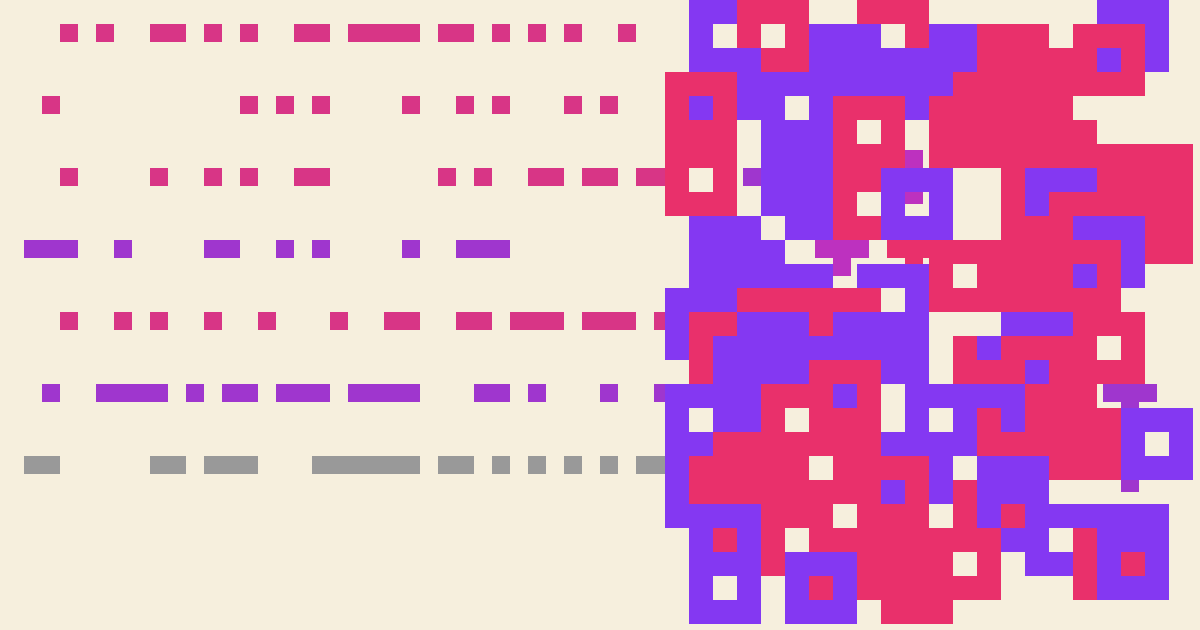
Interfaces also change what automation does. A tool that needs its operator to remember the surrounding context, with high \(h_m\), are likely to stay embedded within that job (top). And under specific local conditions, the containing job actually widens even as its human task time falls. A machine with that brings context with it, dropping \(h_m\), creates a free place to split the work (bottom). In this way, identical task removal can produce opposite job designs.
The model leaves out apprenticeship, accountability, incentives, regulation, identity and social ties, all of which can keep tasks together; we should remember these factors during times when jobs are being redesigned. Context-transfer cost is one reason jobs have their current shape. If you make that easier or harder, jobs can change before the machine has anything to do with it.