

Anthropic posted this report at the beginning of December, 2025, and so far as I can tell it's the best view into how Claude Code is changing work and organizations. My general feeling as a non-technical person using CC for technical work that I otherwise wouldn't be able to do is that, yeah, all of these findings generalize into all other knowledge-work domains.
This paper is also good, but it's different and more constrained to specific agents, not a broader general purpose technology like CC is turning out to be. This NBER working paper surveying 776 P&G employees indicates that these tools replace some of the core benefits of teamwork, including performance, cross-functional expertise, and even some social/emotional lift.
- Engineers reported using Claude for about 60% of their work and self‑assessed ~50% average productivity gains compared with traditional workflows.
- Usage data indicates Claude Code can now execute roughly ~20 consecutive actions before human input is needed, and the share of feature‑implementation tasks climbed from ~14% to ~37% over six months, signalling deeper utility beyond trivial tasks.
- Most employees felt they could fully delegate only about 0–20% of their work to Claude, meaning most tasks still require human verification, oversight, or involvement.
Of course the thing is good at doing stuff. Not always, and not perfectly, but it works. The meat for org designers is in the qualitative feedback:
- Engineers describe evolving into AI collaborators: often becoming more full‑stack as Claude helps them step into domains outside their original expertise. “It did a way better job than I ever would’ve. I would not have been able to do it, definitely not on time... [The designers] were like ‘wait, you did this?’ I said “No, Claude did this - I just prompted it.’"
- But they also report fewer mentorship interactions and reduced team touchpoints, as colleagues often turn to Claude first rather than each other.
- Concerns about skill atrophy and social/organizational change are emerging alongside the productivity gains.
What this means beyond Anthropic: teams and OD leaders will need new guardrails around agent delegation, and reinforced apprenticeship loops to ensure skills, collaboration, and social capital don’t erode even as AI boosts output. I also foresee AI-native organizations caring substantially less about things like "role clarity," and "opportunities for growth and development." AI has made these concepts obsolete and in the case of the former, perhaps even undesirable or stifling.
Not for nothing, one of my favorite findings for my particular brain chemistry is this bit:
In general, people were enthused by their new ability to prototype quickly, parallelize work, reduce toil, and generally raise their level of ambition. One senior engineer told us, “The tools are definitely making junior engineers more productive and more bold with the types of projects they will take on.” Some also said that the reduced “activation energy” of using Claude enabled them to defeat procrastination more easily, “dramatically decreas[ing] the energy required for me to want to start tackling a problem and therefore I'm willing to tackle so many additional things.”
That is so extremely on the nose for me.
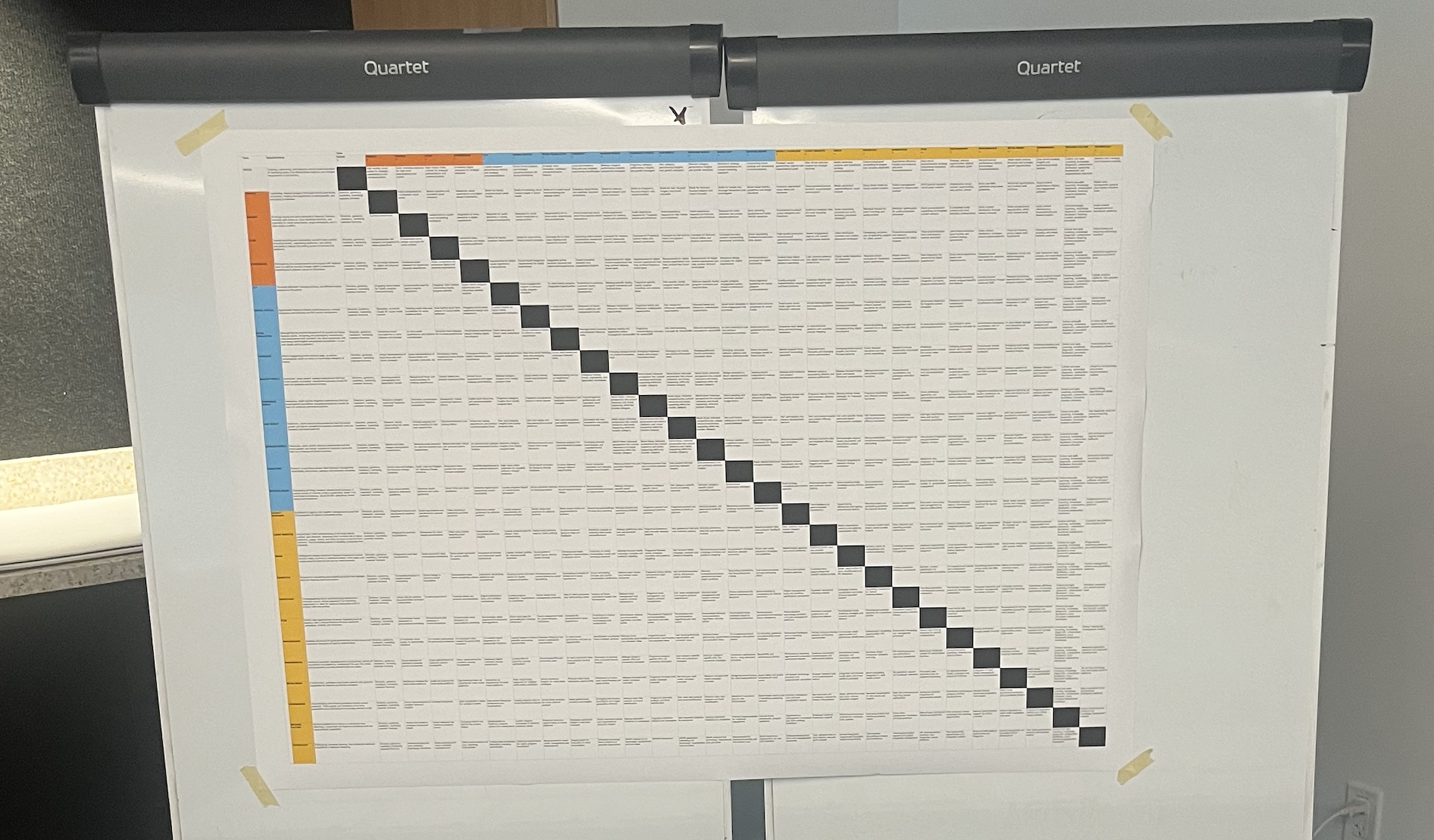
Early in '24 I was working on an OD project and, as we were recommending a 13. Network of Teams model, I had the idea that we should create a comprehensive give-get matrix for each of the 47 teams we'd imagined for the future. Asking a human teammate to do this would have been...punitive. This sort of thing exceeds the "context window" for any mortal being; it would have taken weeks. AI has no problem with this kind of thing.